Welcome to BKPOWER!









.png)
.png)

UPS KWh to Ah Conversion
UPS KWh to Ah Conversion: Simplify Energy Calculations with Our Calculator
Converting kWh in the realm of electrical energy and power, understanding the relationship between kilowatt – hours (kWh) and amp – hours (Ah) is crucial. Whether you’re an electrical engineer, a DIY enthusiast, or a business owner looking to optimize your power systems, this conversion knowledge can help you make informed decisions about energy consumption, battery capacity, and power supply selection. In this in – depth article, we’ll explore the ins and outs of converting kWh to Ah, and how this knowledge is particularly relevant when it comes to choosing the right Uninterruptible Power Supply (UPS) systems. We’ll also showcase how BKPOWER’s range of UPS products, with their advanced battery technologies and intelligent power management, stand out in the market.

I. Understanding Kilowatt – Hours (kWh) and Amp – Hours (Ah)
1. What is a Kilowatt – Hour (kWh)?
A kilowatt – hour is a unit of energy commonly used to measure the amount of electrical energy consumed over a period of time. One kilowatt – hour is equivalent to the energy consumed by a one – kilowatt (1000 – watt) electrical device operating for one hour. It is a convenient unit for measuring the total energy usage of households, businesses, and industrial facilities over longer durations, such as monthly or yearly. For example, if a 100 – watt light bulb is left on for 10 hours, it consumes 100 watts × 10 hours = 1000 watt – hours, or 1 kWh of energy.
2. What is an Amp – Hour (Ah)?
An amp – hour is a unit of electric charge, representing the amount of electric current (in amperes) that a battery or power source can deliver continuously for one hour. It is primarily used to specify the capacity of batteries. A higher amp – hour rating indicates a larger – capacity battery that can store more electrical charge and supply more current over a given period. For instance, a 12 – volt battery with a 50Ah rating can theoretically supply 50 amperes of current for 1 hour, or 1 ampere of current for 50 hours, assuming a constant load.
II. The Conversion Formula: kWh to Ah
The conversion from kilowatt – hours to amp – hours is not straightforward as they measure different aspects of electrical quantities. However, with the knowledge of voltage (V), the conversion can be achieved using the following formula:
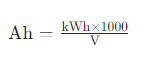
Here’s a breakdown of how the formula works:
First, we convert kWh to watt – hours by multiplying by 1000 since 1 kWh = 1000 Wh.
Then, we use the relationship between power (P in watts), voltage (V in volts), and current (I in amperes), which is

Rearranging this formula for current gives

In the context of our conversion, we want to find the current (in amperes) that can be supplied for one hour (i.e., amp – hours), so we divide the watt – hours by the voltage to get the amp – hours.
For example, let’s say we have a 10 kWh battery system operating at a voltage of 48 volts. To convert this to amp – hours:

III. Importance of kWh to Ah Conversion in UPS Systems
In Uninterruptible Power Supply (UPS) systems, understanding the conversion between kWh and Ah is of great significance for several reasons:
1. Battery Capacity Assessment
UPS systems rely on batteries to provide backup power during outages. Knowing the battery capacity in both kWh and Ah helps users evaluate how long the UPS can support their connected devices. A higher Ah or kWh rating means the battery can store more energy and supply power for a longer duration. For example, in a data center where critical servers and networking equipment need to stay operational during a power outage, accurately assessing the battery capacity using kWh to Ah conversion ensures that the chosen UPS can provide sufficient backup time to safely shut down the systems or keep them running until the main power is restored.
2. Load Matching
Different electrical devices have varying power requirements. By converting the energy consumption of the connected loads from kWh to Ah (and considering the UPS’s operating voltage), users can ensure that the UPS’s battery capacity is adequate to handle the load. If the load’s power demand in terms of Ah exceeds the battery’s capacity, the UPS may not be able to provide the required backup time, leading to premature system shutdowns and potential data loss or equipment damage.
3. System Design and Upgrade
When designing a new UPS system or upgrading an existing one, engineers and facility managers need to calculate the appropriate battery capacity based on the expected load and backup time requirements. The kWh to Ah conversion plays a vital role in this process, enabling them to select the right battery banks and configure the UPS system for optimal performance.
IV. BKPOWER’s UPS Products: Superior Battery Technologies and Capacity Optimization
BKPOWER takes pride in offering a diverse range of UPS products that incorporate advanced battery technologies and intelligent power management features, making the most of the kWh to Ah conversion principles for enhanced performance.
1. High – Quality Battery Options
Our UPS systems are available with a variety of battery chemistries, including lead – acid and lithium – ion. Lithium – ion batteries, in particular, offer several advantages in terms of kWh to Ah conversion. They have a higher energy density, which means that for a given physical size and weight, they can store more energy (higher kWh rating) and deliver more charge (higher Ah rating). For example, BKPOWER’s high – end lithium – ion – based UPS models can provide significantly longer backup times compared to traditional lead – acid – based units with the same physical dimensions, thanks to their superior energy storage capabilities.
2. Intelligent Battery Management Systems
BKPOWER’s UPS products are equipped with intelligent battery management systems that optimize the use of battery capacity. These systems continuously monitor the battery’s state of charge, voltage, and temperature. By accurately tracking these parameters, the battery management system can provide more precise estimates of the available backup time in terms of both kWh and Ah. For instance, it can adjust the power output of the UPS based on the remaining battery capacity, ensuring that the connected devices receive the necessary power while maximizing the backup duration. This intelligent management not only enhances the reliability of the UPS system but also extends the lifespan of the batteries, reducing the overall cost of ownership.
3. Customizable Capacity Configurations
We understand that different customers have different power requirements. That’s why BKPOWER offers customizable UPS solutions. Whether you need a small – scale UPS for a home office with a specific kWh or Ah backup requirement or a large – scale industrial – grade UPS for a manufacturing facility, our products can be configured accordingly. Our technical team works closely with customers to calculate the optimal battery capacity based on their load profiles and backup time needs, ensuring that the UPS system provides the most efficient and reliable power protection.
V. Real – World Examples of kWh to Ah Conversion in BKPOWER’s UPS Applications
1. Home Office Setup
Consider a home office with a total load of 500 watts, and the user wants a backup time of 2 hours. First, we calculate the energy consumption during the backup period in kWh: \(500 \text{ watts} \times 2 \text{ hours} = 1000 \text{ watt – hours} = 1 \text{ kWh}\). If the UPS operates at a voltage of 12 volts, using the conversion formula, the required battery capacity in Ah is \(\frac{1 \times 1000}{12} \approx 83.33 \text{ Ah}\). BKPOWER offers a range of small – scale UPS units that can be customized to meet this capacity requirement, ensuring that the home office equipment, such as computers, routers, and printers, remains powered during short – term power outages.
2. Industrial Facility
In an industrial facility, there may be a large number of high – power – consuming devices, and the backup time requirement could be several hours. Suppose the total load is 100 kilowatts, and a 4 – hour backup time is needed. The total energy consumption during the backup period is \(100 \text{ kW} \times 4 \text{ hours} = 400 \text{ kWh}\). If the UPS system operates at a voltage of 480 volts, the required battery capacity in Ah is \(\frac{400 \times 1000}{480} \approx 833.33 \text{ Ah}\). BKPOWER’s industrial – grade UPS products can be configured with high – capacity battery banks to meet such demanding requirements, providing reliable backup power to keep the industrial processes running smoothly during power disruptions.
VI. Conclusion
Converting kWh to Ah is an essential skill in the electrical and power management fields. It provides valuable insights into battery capacity, load matching, and system design, especially when it comes to Uninterruptible Power Supply (UPS) systems. BKPOWER’s commitment to innovation and quality is evident in our range of UPS products, which leverage advanced battery technologies and intelligent power management to optimize the use of energy storage. Whether you’re a homeowner looking to protect your home office equipment or an industrial manager in charge of a large – scale facility, BKPOWER has the right UPS solution for you. With our expertise and customizable products, we can help you make the most of the kWh to Ah conversion principles and ensure reliable power protection for your valuable assets. Contact BKPOWER today to explore our UPS product range and find the perfect solution for your power backup needs.
References
- International Electrotechnical Commission (IEC)Official website: www.iec.ch
- Underwriters Laboratories (UL)Official website: www.ul.com
- European Committee for Standardization (CEN)Official website: www.cen.eu
- Standardization Administration of China (SAC)Official website: www.sac.gov.cn
- Zhongguancun Energy Storage Industry Technology Alliance (CNESA)Official website: www.cnESA.org
- International Organization for Standardization (ISO)Official website: www.iso.org