Welcome to BKPOWER!












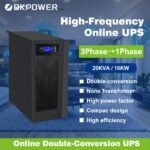
BK-L31-20KVA丨3 Phase in/1 Phase out High-Frequency Online UPS

-sub-1.jpg)
-sub-3.png)
-sub-2.jpg)
-sub-3.jpg)
-sub-5.jpg)
-sub-4.jpg)
-sub-1-150x150.jpg)
-sub-3-150x150.png)
-sub-2-150x150.jpg)
-sub-3-150x150.jpg)
-sub-5-150x150.jpg)
-sub-4-150x150.jpg)
PRODUCT PARAMETERS
The BK-L31 Series 3 Phase In/1 Phase Out High-Frequency Online Double-Conversion UPS leverages a transformerless, high-frequency architecture and is powered by dual high-performance DSP controllers for fully digital management of rectification, inversion, battery charging, and discharging.
- True Online Double-Conversion Technology
- Advanced High-Frequency Transformerless Design
- Ultra-Wide Input Voltage & Frequency Range
- High Efficiency & Energy Savings
- Full Digital DSP Control
Description
FAQs
Request A Quote
Description
Product Overview
The BK-L31 Series is a high-performance Double Conversion UPS engineered for medium-to-large sensitive loads, featuring three-phase input and single-phase output. As a premium High-frequency double-conversion UPS, it adopts true online double-conversion architecture, enabling 0ms seamless transfer between mains and battery modes—completely isolating critical loads from grid fluctuations, harmonics, surges, and outages.
This online UPS supports customizable external battery configurations to meet extended backup time requirements, paired with a wide input voltage range and high input power facto. As a Transformerless online UPS (high-frequency design), it delivers a stable pure sine wave output with low harmonic distortion, making it an ideal Uninterruptible Power Supply for industrial control systems, data centers, medical equipment, and other mission-critical scenarios globally.
Applications
This versatile online UPS caters to diverse high-reliability scenarios, leveraging its three-phase input flexibility and external battery advantage:
Industrial Control Systems
Protects PLCs, automated production lines, CNC machines, and industrial robots. This Double Conversion UPS withstands grid instability and suppresses electromagnetic interference, avoiding costly production downtime.
Data Centers & IT Rooms
Powers servers, storage arrays, and network switches. The 0ms transfer time of this High-frequency double-conversion UPS prevents data loss, while low harmonic distortion ensures compatibility with precision IT equipment.
Medical Equipment
Supports high-power medical devices (e.g., diagnostic scanners, laboratory instruments). This Uninterruptible Power Supply delivers stable output voltage and low leakage current, meeting medical-grade power quality requirements.
Commercial Infrastructure
Covers financial server rooms, communication base stations, and smart building control systems. The wide input range of this UPS System adapts to complex urban grid environments.
Energy & Transportation
Powers new energy station monitoring systems, substation automation equipment, and rail transit signal systems.
Product Features
Three-Phase Input/Single-Phase Output Design
Adapted to medium-to-large three-phase power systems worldwide, while supporting single-phase sensitive loads—ideal for industrial and commercial scenarios where three-phase grid access is available but loads require single-phase power.
True Double Conversion UPS Architecture
0ms transfer time between mains and battery modes; the inverter powers the load continuously, eliminating downtime risks for critical equipment— a core advantage of Double Conversion UPS.
High-Frequency Online UPS Design
Leverages a transformer-less high-frequency topology, enhancing power density and reducing energy loss—aligning with global energy-saving trends and lowering operational costs.
Wide Input Voltage Adaptability
Handles grid sags and surges without frequent battery activation, adapting to unstable grid conditions across regions.
Comprehensive Overload Protection
Multi-stage overload handling in AC and battery modes safeguards the UPS System and connected devices from damage, complying with international safety standards.
Specifications
| Model | BK-L31-20KVA | |
| Capacity | 20KVA/16KW | |
| Phase | Three-phase input, single-phase output | |
| Input | Rated Voltage | 380/400/415VAC |
| Voltage Range | 208-478VAC (three-phase, 50% load); 304-478VAC (100% load) | |
| Frequency Range | 46-54Hz (@50Hz system); 56-64Hz (@60Hz system) | |
| Input Power Factor | ≥0.99 (100% load) | |
| Output | Rated Voltage | 380/400/415VAC ±1% |
| Frequency Range | Mains mode: Synchronized with input; Battery mode: 50/60Hz ±0.1Hz | |
| Waveform | Pure Sine Wave | |
| THD | ≤3% (@100% linear load); ≤8% (@100% non-linear load) | |
| Overload Capability | AC Mode: 100%-110%: 60min; 110%-130%: 30min; >130%: 1min | |
| Battery Mode: 100%-110%: 60min; 110%-130%: 30min; >130%: Immediate shutdown | ||
| Transfer Time | Mains ↔ Battery: 0ms; Inverter ↔ Bypass: ≤4ms | |
| Current Crest Ratio | 3:1 | |
| Battery | Battery Type | External Battery |
| Battery Voltage | Customizable to 240VDC | |
| Battery Count | Customizable to 20 units | |
| Charging Current | 4A~6A | |
| Efficiency | AC Mode | 91% |
| Battery Mode | 91% | |
| Indicators | LCD | Load Level,Battery Level,AC Mode,Battery Mode,Bypass Mode,and Fault Indicator Via LCD |
| Environmental | Operating Temperature | 0~40℃ |
| Humidity | <95% RH (non-condensing) | |
| Noise Level | ≤58dB@1meter | |
| Communication & Monitoring | RS232 (485 optional); Smart slot (SNMP optional); SMS alert (optional) | |
| Dimensions (W×D×H) | 525×248×613mm | |
| Weight | 15.3kg | |
Kindly note: The technical parameters provided here are for reference only and are intended as a selection guide. Given that the product offers various customization options, such as power rating, voltage configuration, battery solutions, and special certifications, the final product specifications will be subject to the final order document.
FAQs
What is UPS?
UPS stands for Uninterruptible Power Supply and is a device that provides a continuous supply of power to protect critical loads from power failures or fluctuations.
What is the main role of UPS?
The main role of a UPS is to provide a backup power source to ensure that critical equipment can continue to operate when utility power is interrupted or unstable, avoiding data loss or equipment damage.
What are the types of UPS?
UPS is mainly divided into three types: offline, online and online interactive.
How to choose the power capacity of UPS?
When choosing the power capacity of the UPS, you need to consider the total power demand of the load, it is usually recommended to choose a slightly larger than the total load power of the UPS to ensure sufficient standby time.
How is the standby time of a UPS determined?
The standby time of a UPS depends on the battery capacity and load power. Standby time usually ranges from 10 minutes to several hours, and the specific needs can be determined according to the actual application scenario.


