Welcome to BKPOWER!












Uninterruptible Power Supply: Enterprise Protection Guide
TIPS:Double conversion UPS technology is reshaping modern power protection architecture. As the core topology of uninterruptible power supply systems, double conversion UPS achieves zero transfer time through AC-DC-AC dual transformation, delivering clean and stable power for data centers, medical equipment, and industrial automation. This guide analyzes technical differences between double conversion UPS and online UPS, provides sizing guidelines from 10kVA to 1000kVA, and reveals industry trends in lithium-ion UPS and modular architectures based on 2025 market data (global UPS market reaching $12.24 billion). Whether planning data center power redundancy or upgrading factory backup power systems, this uninterruptible power supply handbook helps mitigate outage risks and optimize total cost of ownership.

Ⅰ. Uninterruptible Power Supply Systems: The Cornerstone of Power Security in the Digital Age
In today’s highly electricity-dependent business environment, power interruptions can cost thousands of dollars per minute. According to the latest Mordor Intelligence research, the global UPS market is projected to grow from $12.24 billion in 2025 to $15.72 billion by 2031. This growth is driven by rigid demand for uninterruptible power supply systems from cloud computing, AI computing power requirements, and 5G infrastructure expansion.
Double conversion UPS technology, representing the highest level of power protection, is becoming the preferred choice for data centers and mission-critical facilities. Unlike traditional backup power, double conversion UPS completely isolates loads from utility power through continuous AC-DC-AC transformation, eliminating voltage fluctuations, frequency drift, and harmonic pollution. This online UPS architecture ensures sensitive equipment receives pure sine wave power even under extreme grid conditions.
Ⅱ. Deep Dive into UPS Working Principles
- Core Component Synergy
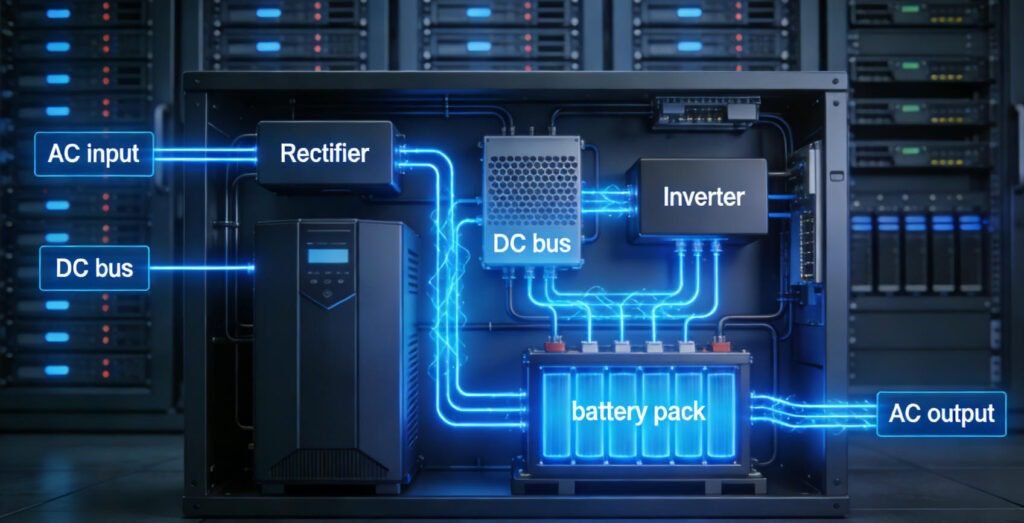
Modern UPS systems comprise five core modules forming a sophisticated power protection network:
- Rectifier/Charger: Converts AC to DC while powering the inverter and charging batteries. In double conversion UPS, the rectifier operates continuously, ensuring batteries remain online.
- Inverter: Converts DC back to pure AC output. High-end online UPS uses IGBT or SiC MOSFET technology, achieving conversion efficiency above 98%.
- Battery Bank: As energy storage units, lithium-ion UPS is rapidly replacing traditional lead-acid batteries, offering 3x energy density and longer cycle life.
- Static Bypass: Switches to utility bypass in <4 milliseconds during UPS failure or overload, ensuring uninterrupted load power.
- Intelligent Control Unit: Modern UPS systems feature AI-driven predictive maintenance, warning of battery failures 90 days in advance.
- Unique Advantages of Double Conversion Technology
The core value of double conversion UPS (also called VFI, Voltage and Frequency Independent) lies in complete electrical isolation. After rectification, all power passes through battery buffering before being regenerated by the inverter. This process completely filters:
- Voltage sags and swells
- Harmonic distortion (THD)
- Frequency variations
- Electromagnetic interference (EMI)
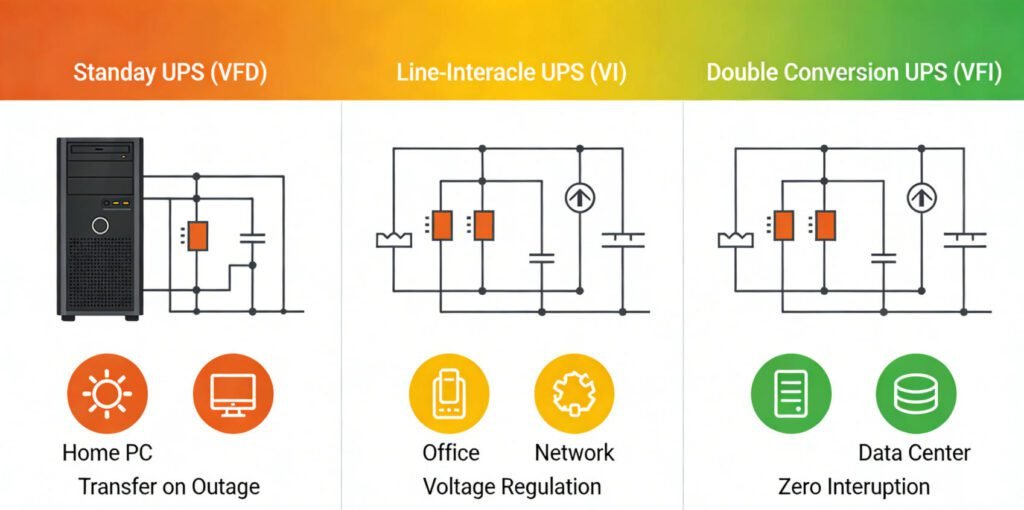
In contrast, standby UPS (VFD) only activates the inverter during outages, with 2-10 millisecond transfer delays, unsuitable for precision servers and medical equipment.
Ⅲ. UPS System Types and Application Matching
Technical Features: Continuous AC-DC-AC conversion, zero transfer time, output voltage regulation ±1%
Best Application Scenarios:
- Hyperscale Data Centers
- Financial trading systems and HFT platforms
- Medical imaging equipment (MRI, CT scanners)
- Semiconductor manufacturing and precision laboratories
Market Trends: In 2024, online double conversion UPS held 58.1% of the industrial UPS market share. Schneider Electric’s 2025 Galaxy VXL series achieves 99% eConversion mode efficiency, reducing losses below 1%.
- Line-Interactive UPS (VI)
Technical Features: Inverter operates in parallel, providing voltage regulation, transfer time <10 milliseconds
Best Application Scenarios:
- SME server rooms
- Retail POS systems and branch banks
- 5G base stations and edge computing nodes
- Urban commercial areas with relatively stable grid quality
Efficiency Advantage: In stable grid regions, line-interactive UPS achieves 95-98% efficiency, 3-5 percentage points higher than double conversion UPS. However, in areas with frequent voltage fluctuations (e.g., India, Nigeria), battery charge/discharge cycles reduce lifespan.
- Standby UPS (VFD)
Technical Features: Utility power direct supply, switches to battery inverter during outages, transfer time 2-10 milliseconds
Application Limitations: Only suitable for non-critical loads such as:
- Personal workstations and home PCs
- Office printers and network routers
- Security monitoring systems
Important Warning: Some manufacturers market standby UPS as “line-interactive”. Always verify VI (Voltage Independent) or VFI certification labels when purchasing.
Ⅳ. UPS Sizing and Configuration Strategies
- Power Calculation Methodology
Accurate load assessment is the first step in UPS sizing. Total load power (kW) = Sum of all equipment rated power × Diversity factor (typically 0.8). For data center UPS, also consider:
- AI server power density: NVIDIA H100 GPU racks exceed 35kW, 3x traditional servers
- Power factor (PF): Modern UPS power factor reaches 0.9-1.0, allowing 100kVA UPS to output 90-100kW real power
- Future expansion: Recommend 20-30% capacity margin, using modular UPS for “pay-as-you-grow” deployment
- Battery Backup Time Design
UPS battery runtime depends on two boundary conditions:
No Generator Scenario: UPS thermal limits typically support 30-60 minutes operation. Beyond this duration, UPS triggers thermal protection shutdown. Therefore, long-duration batteries (>1 hour) without supporting cooling solutions represent wasted investment.
With Generator Scenario: Standard 5-15 minute battery configuration covers generator startup (<30 seconds) and stabilization time. Financial and medical facilities often use N+1 redundant generators, with UPS serving only as transition protection.
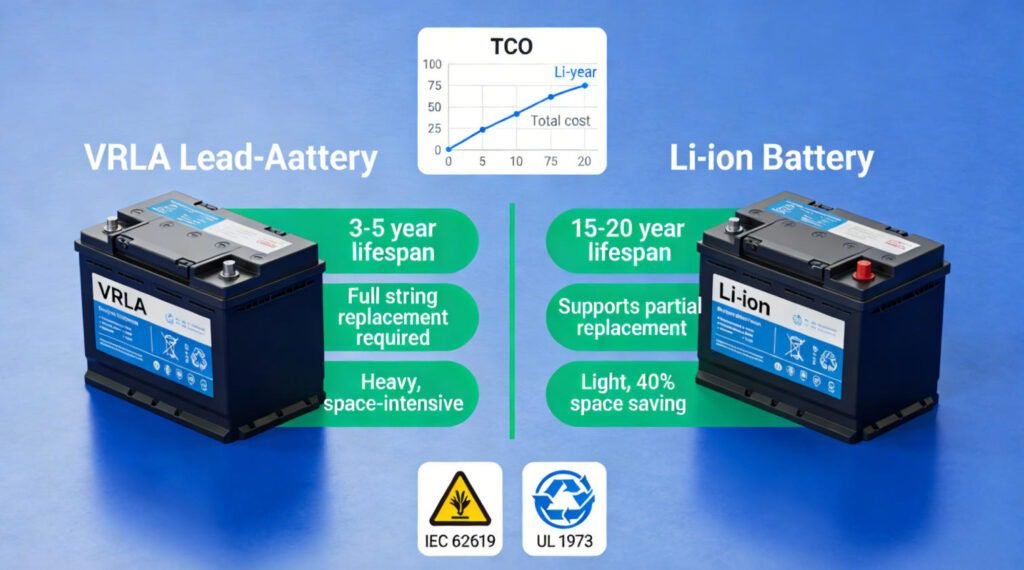
Lithium-ion Revolution: In 2025, lithium-ion UPS penetration in data centers is accelerating rapidly. Compared to VRLA lead-acid batteries, lithium-ion offers:
- 40% space savings
- 8kW/MW cooling load reduction (saving $75,000 annually)
- 15-20 year lifespan (VRLA only 3-5 years)
- Topology Selection: Centralized vs Distributed
Centralized UPS:
- Single high-power UPS (>500kVA) protects entire facility
- Advantages: Unified management, high redundancy (2N or 2N+1)
- Suitable for: Hyperscale data centers, semiconductor plants
Distributed UPS:
- Rack-level UPS (1-10kVA) or row-level UPS (50-200kVA)
- Advantages: Fault isolation, proximity power supply, reduced distribution losses
- Suitable for: Edge computing nodes, modular data centers
According to GM Insights data, distributed UPS grew 5.5% in the SME market in 2024, compared to 3.2% for centralized solutions.
Ⅴ. 2025 UPS Market Trends and Technology Evolution
- Market Growth Drivers
The global UPS market is experiencing structural growth. Precedence Research forecasts market size will increase from $9.92 billion in 2025 to $14.84 billion by 2035 (CAGR 4.11%). Key drivers include:
- Surging data center power demand: International Energy Agency (IEA) projects global data center electricity consumption will grow from 415TWh in 2024 to 945TWh by 2030
- AI computing expansion: AI servers already account for 20% of data center power consumption, expected to double by end of 2025
- 5G infrastructure: 127,000 new 5G base stations globally in 2025, each requiring 3-10kVA UPS protection
- Four Technology Evolution Directions
Silicon Power Device Upgrade: Silicon Carbide (SiC) MOSFET replacing traditional IGBT enables double conversion UPS efficiency to break 98%, saving 120kW cooling load per MW.
Modular Architecture Adoption: Modular UPS supports hot-swappable maintenance, allowing failed module replacement without load impact. Eaton 93PM G2 supports 50-600kW flexible expansion; Schneider Galaxy VXL achieves 500-1250kW modular deployment.
Battery-as-a-Service (BaaS): Schneider Electric and ABB launched BaaS models, bundling UPS hardware, lithium batteries, and 10-year maintenance into monthly service fees (from $8,500/100kVA), converting CapEx to OpEx.
AI-Driven Predictive Maintenance: Machine learning analyzes battery impedance, temperature, and internal resistance changes, warning of failures 90 days in advance and extending battery life by 20%.
- Regional Market Landscape
- North America: Largest market, 42.3% global share, US data center UPS demand accounts for 75% globally
- Asia-Pacific: Fastest growing, China’s data center power demand expected to grow 170%, India’s manufacturing automation driving industrial UPS demand
- Europe: Leading green energy integration, Germany’s Legrand launched Keor MOD series in 2024 emphasizing hot-swap and intelligent energy management
Ⅵ. UPS Purchasing Decision Checklist
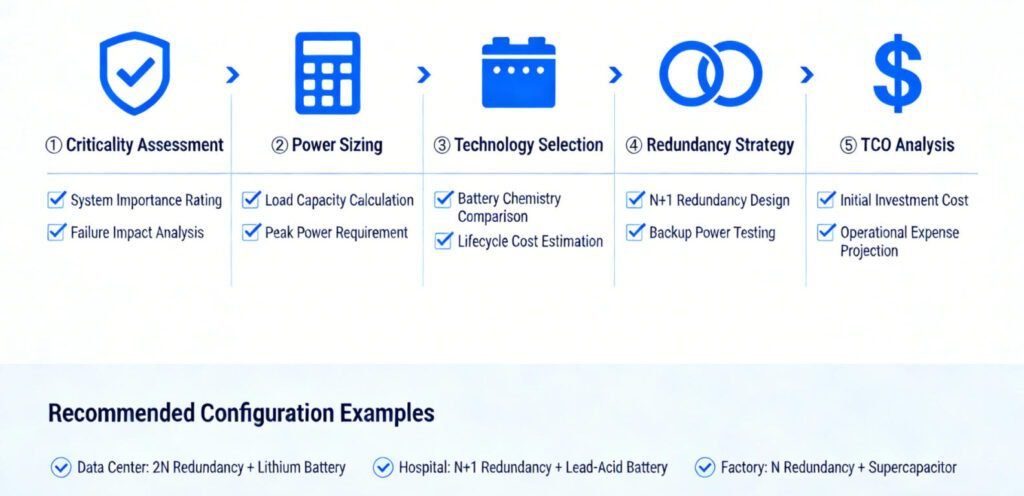
Based on the above analysis, we summarize key decision elements:
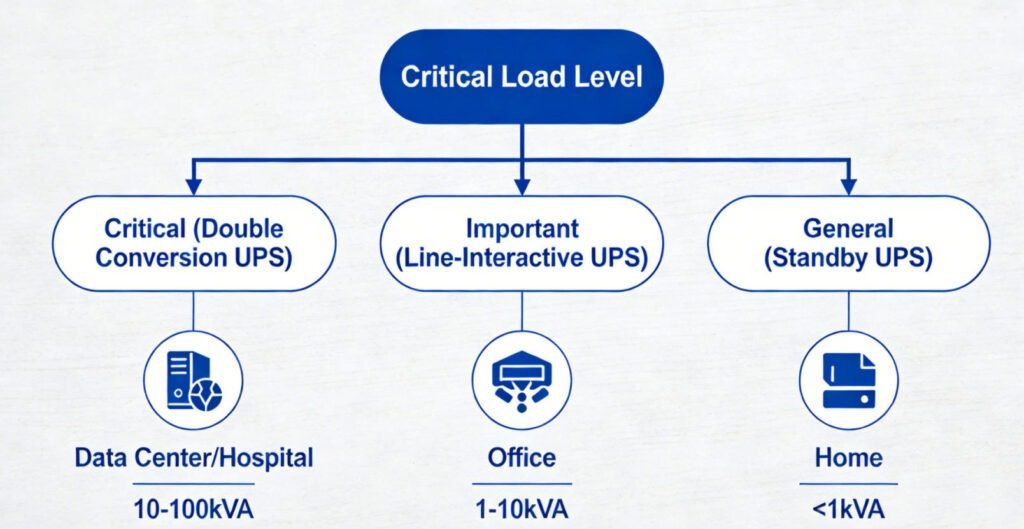
1. Determine Load Criticality
- Mission-critical (financial trading, life support): Must choose double conversion online UPS
- Important business (enterprise ERP, communications): Line-interactive UPS meets requirements
- General office (document processing, printing): Standby UPS cost-effective
2. Calculate Actual Power Requirements
- List all protected equipment power ratings
- Apply diversity factor (0.7-0.9)
- Consider 3-5 year future expansion (+30% margin)
- Confirm UPS power factor (PF≥0.9)
3. Select Battery Technology
- Standard applications (<5 year cycle): VRLA lead-acid (lower cost)
- Long-cycle applications (>10 years): Lithium-ion (better TCO)
- Extreme temperature environments: Nickel-cadmium (Ni-Cd, -20°C to +50°C)
4. Determine Redundancy Strategy
- N configuration: No redundancy, suitable for non-critical loads
- N+1 configuration: One standby unit, suitable for most commercial applications
- 2N configuration: Full redundancy, suitable for Tier III/IV data centers
5. Evaluate Total Cost of Ownership (TCO)
- Initial acquisition cost (only 20-30% of total cost)
- 10-year battery replacement cost (VRLA requires 2-3 replacements)
- Energy costs (each 1% efficiency improvement saves $10,000/100kW over 10 years)
- Maintenance costs (remote monitoring reduces 30% on-site service)
Ⅶ. Conclusion: Building Resilient Power Infrastructure
In the deep waters of digital transformation, double conversion UPS has evolved from optional accessory to standard equipment for critical infrastructure. With AI computing density exceeding 35kW per rack, traditional power architectures face severe challenges. Enterprises need to balance reliability, efficiency, and sustainability in uninterruptible power supply system selection.
The 2025 UPS market presents clear trends: accelerated lithium-ion adoption, modular architecture proliferation, and mature AI operations. For decision-makers, the key is breaking free from “purchase cost only” thinking, adopting total lifecycle cost (LCC) perspective to evaluate online UPS investments. As Mordor Intelligence reports show, enterprises adopting Battery-as-a-Service models can reduce initial investment by 40% while gaining more professional battery management services.
Whether building new hyperscale data centers or upgrading existing factory industrial UPS systems, we recommend establishing strategic partnerships with vendors possessing global service networks (such as Eaton, Schneider Electric, Vertiv, Huawei). In an era where power interruption costs can reach $10,000 per minute, professional UPS systems are not just insurance, but the cornerstone of business continuity.
References
- International Electrotechnical Commission (IEC)Official website: www.iec.ch
- Underwriters Laboratories (UL)Official website: www.ul.com
- European Committee for Standardization (CEN)Official website: www.cen.eu
- Standardization Administration of China (SAC)Official website: www.sac.gov.cn
- Zhongguancun Energy Storage Industry Technology Alliance (CNESA)Official website: www.cnESA.org
- International Organization for Standardization (ISO)Official website: www.iso.org