Bienvenue chez BKPOWER !









.png)
.png)

Smart Checklist: Buying Industrial UPS & Line Frequency Guide
TIPS:Buying an industrial UPS system requires more than comparing spec sheets. It demands a systematic evaluation of topology, environment, and lifecycle costs. This smart checklist provides ten critical decision points for specifying line frequency UPS solutions in demanding applications. Unlike generic buying guides, we focus on why line frequency UPS architecture outperforms high-frequency alternatives in industrial environments. From load characterization to battery room engineering, each checklist item includes verification criteria. Use this industrial UPS system procurement framework to eliminate costly specification errors. Ensure your power protection investment matches operational reality for the next 15-20 years.

Ⅰ. The Smart Checklist Framework
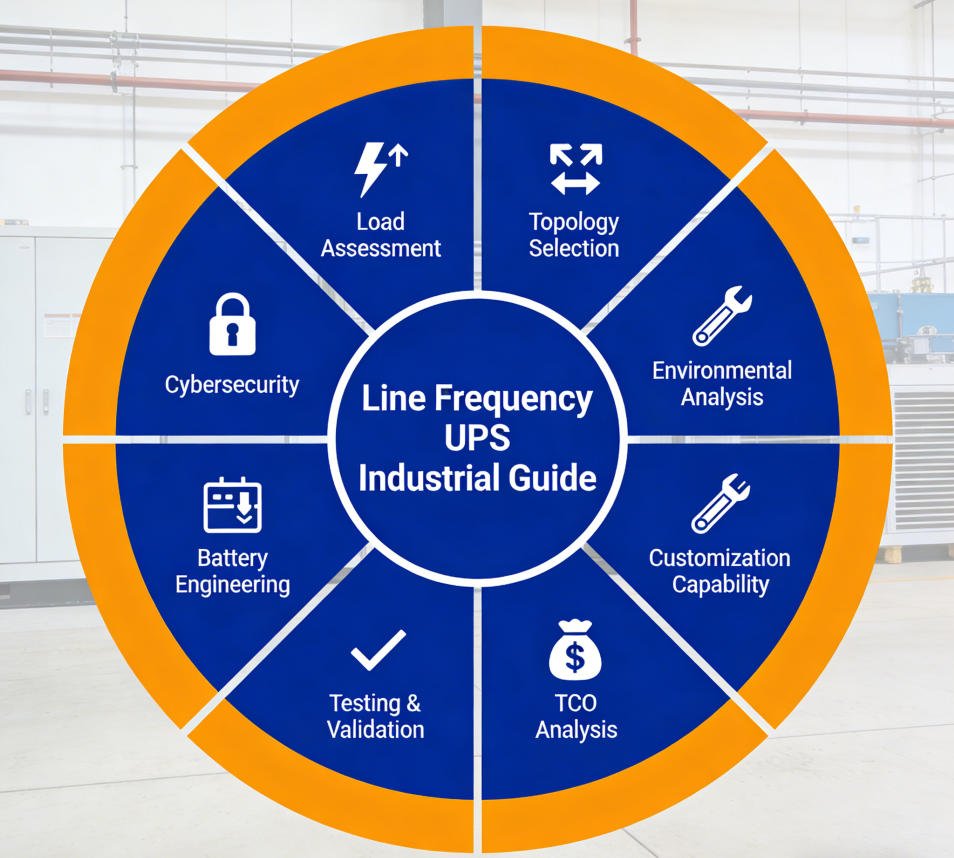
Most checklists collect features. This checklist evaluates risks. Each of the eight points includes verification questions. Positive answers indicate readiness to specify. Negative answers reveal gaps requiring attention before procurement.
The framework serves buyers of industrial UPS system solutions from 10KVA to 500KVA. It emphasizes line frequency UPS topology where environmental harshness demands transformer-based isolation. Use it as a living document throughout your procurement cycle.
Ⅱ. Point 1: Load Reality Assessment
1. Characterize Your Electrical Load Profile
Critical loads vary dramatically. Motor drives draw 600% inrush current. CNC machines generate regenerative energy. Medical imaging requires microsecond-level power stability.
Verification questions:
- Do you have documented crest factor measurements?
- Have you logged voltage sag/swell occurrences over 30 days?
- Can your loads tolerate 4-10ms transfer time, or do you need zero transfer?
If regeneration or inrush dominates, line frequency UPS with 300% overload capacity becomes mandatory. High-frequency units trip under these stressors.
2. Calculate True Power Requirements
Convert watts to VA using actual facteur de puissance, not assumed 0.9. Industrial loads often run at 0.7-0.8 power factor. Add 125% safety margin for growth. Include future expansion plans.
Document your VA and watt calculations. Mismatch between UPS rating and load creates either underutilization (inefficiency) or overload (failure risk).
Ⅲ. Point 2: Topology Selection Logic

1. High-Frequency vs. Line Frequency Decision Matrix
High-frequency UPS uses IGBT switching and aluminum windings. Efficiency reaches 95-96%. Footprint remains compact. These suit clean, stable environments with space constraints.
Line frequency UPS employs copper transformers at 50/60Hz operation. Efficiency runs 90-93%. Weight increases 40-60%. However, magnetic isolation blocks conducted noise. Transformers absorb voltage spikes naturally. Overload capacity reaches 300% versus 110% for high-frequency.
Choose line frequency UPS when your environment includes welding equipment, motor starting, or unstable grids. Accept the efficiency penalty for survivability gains.
2. Verify Isolation Requirements
Medical applications need 10 microamp leakage maximum. Industrial controls benefit from galvanic isolation. Measure your neutral-ground voltage under load.
If isolation is non-negotiable, transformer-based line frequency UPS is your only option. Transformerless designs cannot provide inherent galvanic separation.
Ⅳ. Point 3: Environmental Stress Analysis
Standard UPS operates 0-40°C. Industrial sites often reach 50°C. Every 10°C above 25°C halves battery life. Dust infiltration destroys cooling fans. Humidity causes tracking failures on PCBs.
Verification questions:
- What is the 99th percentile temperature in your facility?
- Is conductive dust present (metal, carbon, chemical)?
- Do corrosive gases exist (chlorine, sulfur, ammonia)?
If any answer exceeds standard UPS ratings, specify wide-temperature components, IP54/IP66 enclosures, and conformal-coated PCBs. Industrial frequency designs tolerate these stresses better than compact high-frequency units.
Ⅴ. Point 4: Customization Capability Check
1. Voltage and Frequency Flexibility
Global equipment often requires non-standard voltages. Custom input/output transformer taps solve voltage mismatches. Frequency converters enable 50Hz-to-60Hz operation for imported machinery.
Verification:
- Can the supplier provide custom transformer ratios?
- Is field-adjustable voltage available?
- How quickly can custom designs be manufactured?
BKPOWER customizes line frequency UPS configurations within 4-6 weeks. Off-the-shelf restrictions force compromises that create long-term problems.
2. Mechanical Integration
Measure your installation pathway precisely. Doorway clearances, elevator capacities, and floor loading limits constrain options. Battery cabinets exceeding 1,000 kilograms require structural review.
Checklist items:
- Floor loading capacity (kg/m²)
- Minimum doorway height/width
- Ceiling height for battery room hydrogen dispersion
- Maintenance access clearances
Ⅵ. Point 5: Battery System Engineering
1. Chemistry Selection Impact
VRLA batteries offer lower initial cost but require replacement every 3-5 years. Lithium-ion lasts 10-15 years with higher upfront investment. Temperature tolerance varies dramatically by chemistry.
Verification questions:
- Can the UPS accommodate both VRLA and lithium without hardware changes?
- Does the battery management system support impedance monitoring?
- What is the recharge time to 90% capacity?
Grandes dimensions industrial UPS system installations often justify lithium-ion despite higher initial cost. Calculate total battery replacement costs over 15 years.
2. External Battery Cabinet Requirements
Separate battery cabinets create facility demands. Hydrogen evolution requires explosion-proof ventilation. Floor loading must support 2-3 tons concentrated on small footprints. Temperature control extends battery life significantly.
Ensure your supplier provides:
- Complete battery room design guidance
- Hydrogen detection specifications
- Floor loading calculations
- HVAC requirements
Ⅶ. Point 6: Testing and Quality Verification
1. Manufacturing Testing Standards
100% testing beats sampling every time. Verify your supplier burn-in tests at 110% rated load for 48 hours. Parallel operation testing is mandatory for redundant configurations. Communication protocol testing prevents integration failures.
Request documentation:
- Test reports with actual data (not just pass/fail)
- Thermal imaging results
- Communication protocol logs
- Battery discharge curves
2. Component Traceability
Transformer core materials, semiconductor lot codes, and battery serial numbers must be documented. This enables failure analysis and proactive replacement if component batches show defects.
Ⅷ. Point 7: Supplier Capability Assessment
1. Manufacturing Credentials
ISO 9001 certification is baseline, not differentiator. Check for industry-specific certifications: UL listing for North America, CE marking for Europe, IECEx for hazardous locations.
Evaluate manufacturing depth. Does the supplier wind transformers in-house? Do they fabricate enclosures locally? Deep manufacturing integration enables customization and controls quality.
2. Lifecycle Support Commitment
Technical support availability matters more than initial price. 24/7 phone support, local service technicians, and spare parts inventory prevent extended outages.
Verification:
- Average response time for critical failures
- Geographic coverage of service technicians
- Spare parts stocking locations
- Training programs for your maintenance staff
Ⅸ. Point 8: Delivery and Implementation Planning
1. Lead Time Reality
Global brands quote 8-12 weeks. Local manufacturing delivers 4-6 weeks. Emergency failures require 24-48 hour response capability.
Verify:
- Standard lead times for your configuration
- Expedite options and associated costs
- Customs clearance support for international orders
- Installation supervision availability
2. Commissioning Support
Factory acceptance testing at your site validates performance. Load bank testing proves capacity before final payment. Training your staff on operation and maintenance prevents early failures.
Site preparation guidance ensures readiness. Cable sizing calculations prevent voltage drop. Battery room ventilation specs ensure safety. Comprehensive documentation enables smooth commissioning.

Ⅹ. Implementation: Using Your Checklist
1. Scoring Your Options
Evaluate three suppliers against all eight points. Score each 1-5. Weight points by importance to your operation. Total scores reveal objective rankings that cut through marketing claims.
2. Documentation and Review
Record your checklist completion for audit trails. Specification justifications based on this framework withstand procurement scrutiny. Engineering reviews validate technical decisions.
Le industrial ups buyer checklist transforms subjective preferences into objective criteria. Apply it rigorously to navigate the complexity of industrial UPS system procurement successfully.
Références
- Commission électrotechnique internationale (CEI)Site officiel : www.iec.ch
- Underwriters Laboratories (UL)Site officiel : www.ul.com
- Comité européen de normalisation (CEN)Site officiel : www.cen.eu
- Standardization Administration of China (SAC) Site web officiel : www.sac.gov.cn
- Zhongguancun Energy Storage Industry Technology Alliance (CNESA)Site web officiel : www.cnESA.org
- Organisation internationale de normalisation (ISO)Site officiel : www.iso.org