Welcome to BKPOWER!












Residential Inverter丨Off-Grid And On-Grid丨BK-VMIV-6KVA


PRODUCT PARAMETERS
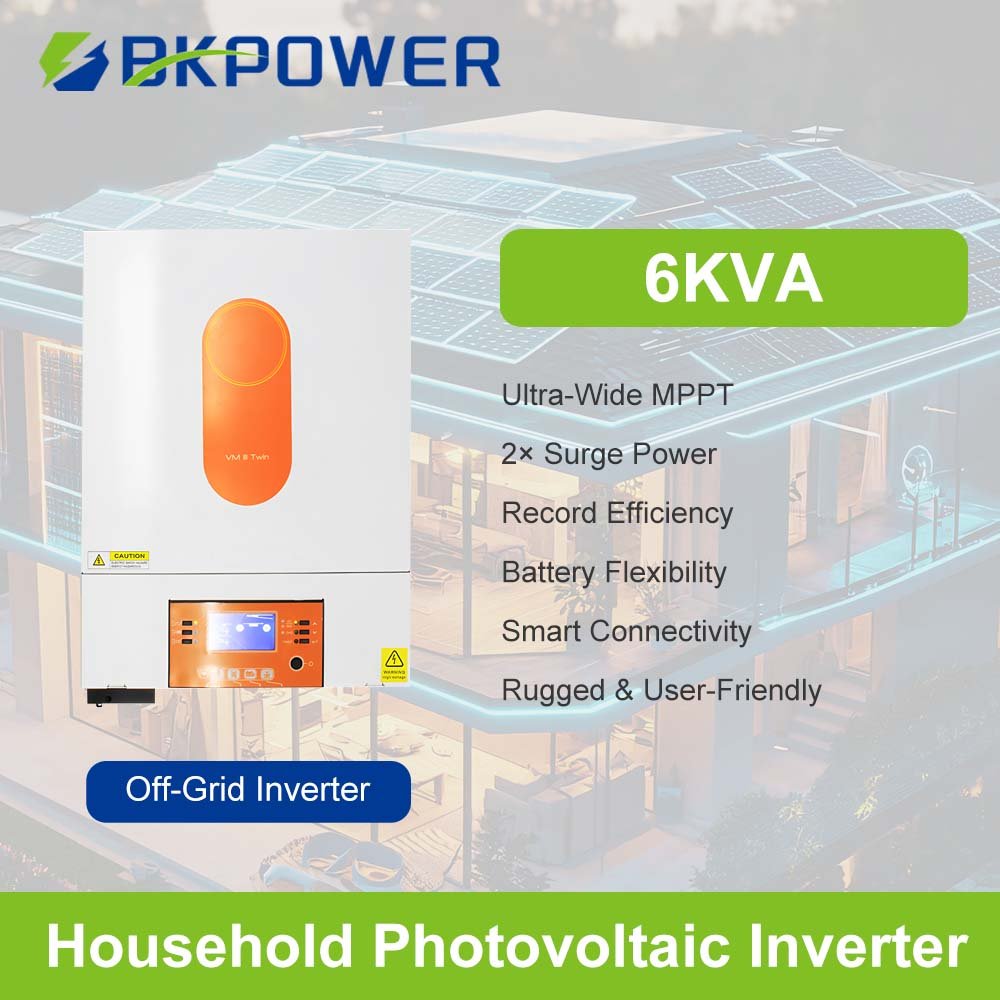
The BK-INV series is a slim, wall-mounted hybrid inverter-charger designed specifically for premium villas, small-to-medium businesses, off-grid micro-grids, and mobile emergency scenarios, integrating an ultra-wide range MPPT solar controller, pure-sine-wave inverter, and smart battery manager.
- Ultra-Wide MPPT for Maximum Solar Harvest
- Zero-Downtime Dual-Output Power Supply
- Extended Battery Compatibility & Safe Charging
- High Reliability for Harsh Environments
- High Scalability via Parallel Operation
- Robust & Slim Structural Design
Description
FAQs
Request A Quote
Description
Product Overview
BK-VMIV-6KVA is a slim, wall-mounted hybrid inverter-charger that combines a 60–450 V MPPT solar controller, pure-sine-wave inverter and smart battery manager in one 470 × 305 × 125 mm, 10 kg chassis. It supports dual outputs for intelligent load management and can be paralleled for larger systems—turning any home, shop or micro-grid into a resilient, revenue-generating energy hub.
Application
- Premium Villas & Large Homes
20 KWh battery + 6 KW inverter for 70–90 % self-consumption and net-metering revenue.
- Small-to-Medium Businesses
Workshops, EV charging stations—sell surplus power while securing critical loads during outages.
- Off-Grid Micro-Grids
Rural villages, islands, telecom shelters—run purely on solar + battery or blend with gensets.
- Retrofit Projects
Drop-in replacement for existing grid-tie inverters to add battery storage, backup power and load management without rewiring.
- Mobile & Emergency Power
Lightweight 10 kg unit ideal for mobile cabins, disaster relief or construction sites—parallel units for higher capacity.
Product Features
- Ultra-Wide MPPT
• 60–450 V DC input, 27 A max current, handles 6 KW of PV and keeps harvesting power even in low-light conditions.
- Dual-Output & Smart Load Management
• Main + auxiliary outputs; priority and shedding settings via 4.3-inch touchscreen or RGB status bar—no extra hardware required.
- 2× Surge Power
• 12 KVA (6 kW model) for 5 seconds—starts heavy motors, pumps or air-conditioners without tripping.
- Record Efficiency
• 93 % battery-to-AC efficiency / 95 % grid-tie efficiency.
- Battery Flexibility
• 48 V (6 KW) platform; 120 A max charge current; Li-ion, AGM or flooded lead-acid compatible.
- Smart Connectivity
• Built-in Wi-Fi (Android/iOS App) + RS485 / CAN / RS232 / USB / dry contact—cloud monitoring and OTA firmware updates ready.
- Rugged & User-Friendly
• –10 °C to +50 °C operation, washable dust filter, snap-on front cover for 3-minute fan swap; orange-white color option for high-end aesthetics.
Specifications
| Model | BK-VMIV-6KVA | |
| Product Type | Residential photovoltaic inverter | |
| Power Capacity | 6000VA/6000W | |
| AC Input | ||
| Voltage | 230VAC | |
| Voltage Range | 170-280Vac (for personal computers) 90-280Vac (for household appliances) | |
| Output | ||
| Voltage | 230VAC±5% | |
| Surge Power | 12000VA | |
| Efficiency | 93% | |
| Switching Time | 10 ms (computers); 20 ms (home appliances) | |
| Waveform | pure sine wave | |
| Battery | ||
| Battery Voltage | 48V | |
| Floating Charge Voltage | 54V | |
| Overcharge Protection | 63V | |
| Photovoltaic Charging & AC Charging | ||
| Photovoltaic Charging Type | MPPT | |
| Maximum Photovoltaic Array Power | 6000W | |
| MPPT Operating Voltage Range | 60~ 450 VDC | |
| Photovoltaic Input Rated Voltage | 360V | |
| Maximum Photovoltaic Array Open-circuit Voltage | 500 VDC | |
| Maximum Photovoltaic Input Current | 27A | |
| Maximum Photovoltaic Charging Current | 120A | |
| Maximum AC Charging Current | 120A | |
| Maximum Charging Current | 120A | |
| Environment | Operating Temperature | -10℃-50℃ |
| Storage Temperature | -15℃-60℃ | |
| Humidity | 5%-95% | |
| Communication | USB/RS232/RS485/WiFi/dry contact | |
| Physical | Dimensions (D×W×H) | 470x305x125mm |
| Weight | 10kg | |
FAQs
What is UPS?
UPS stands for Uninterruptible Power Supply and is a device that provides a continuous supply of power to protect critical loads from power failures or fluctuations.
What is the main role of UPS?
The main role of a UPS is to provide a backup power source to ensure that critical equipment can continue to operate when utility power is interrupted or unstable, avoiding data loss or equipment damage.
What are the types of UPS?
UPS is mainly divided into three types: offline, online and online interactive.
How to choose the power capacity of UPS?
When choosing the power capacity of the UPS, you need to consider the total power demand of the load, it is usually recommended to choose a slightly larger than the total load power of the UPS to ensure sufficient standby time.
How is the standby time of a UPS determined?
The standby time of a UPS depends on the battery capacity and load power. Standby time usually ranges from 10 minutes to several hours, and the specific needs can be determined according to the actual application scenario.