Welcome to BKPOWER!







.png)
.png)

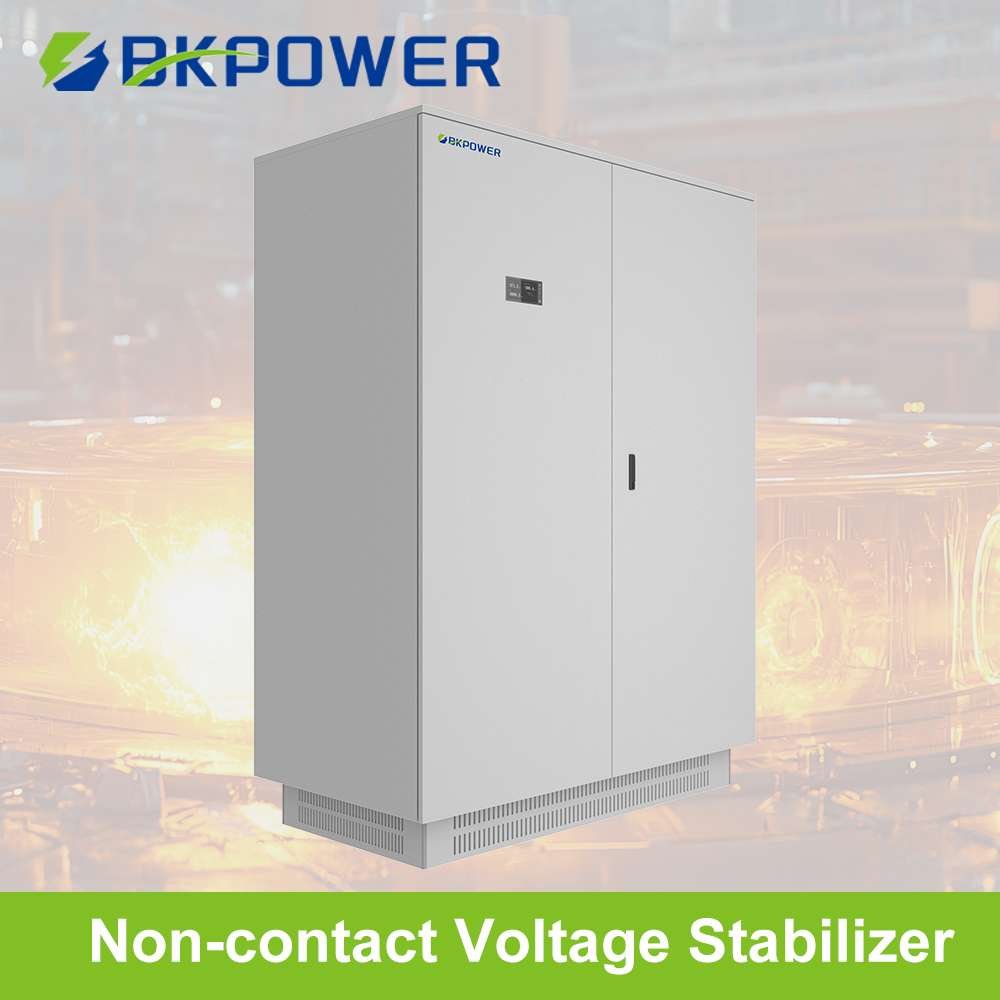
BK-AVR-200KVA丨Three-Phase Non-contact Voltage Stabilizer






PRODUCT PARAMETERS
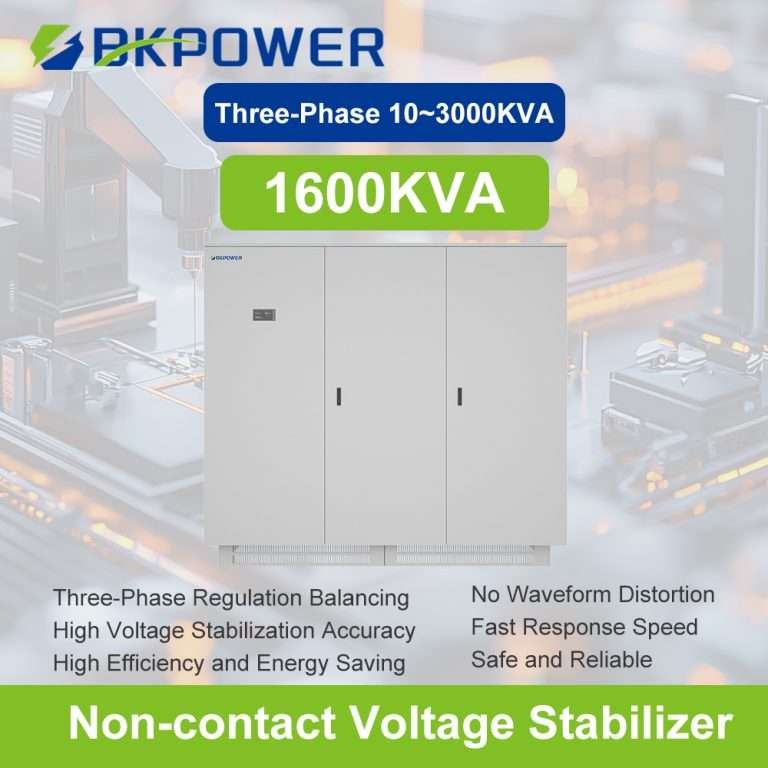
The BKPOWER three-phase non-contact voltage stabilizer is designed for precision and reliability. It uses an SCR module and DSP chip to achieve contactless control. This design ensures high voltage stabilization accuracy, fast response speed, and no mechanical wear and tear.
- Three-Phase Regulation Balancing
- High Voltage Stabilization Accuracy
- High Efficiency and Energy Saving
- No Waveform Distortion
- Fast Response Speed
- Safe and Reliable
Description
FAQs
Request A Quote
Description
Product Overview
The BKPOWER three-phase contactless voltage stabilizer is designed for precision and reliability. It uses an SCR module and DSP chip to achieve contactless control. This design ensures high voltage stabilization accuracy, fast response speed, and no mechanical wear and tear. It is suitable for various fields such as industrial, transportation, power, oilfields, railways, hospitals, and scientific research.
Application
The BK-AVR Series is widely used in the following sectors:
- Industrial Manufacturing: CNC machine tools, automated production lines, industrial robots, welding equipment, etc.
- Data Centers and Communication Base Stations: Server rooms, 5G base stations, network switches, etc.
- Medical and Laboratory Equipment: MRI, CT scanners, high-precision analytical instruments, etc.
- New Energy and Power Infrastructure: Solar/wind farm grid connection points, charging piles, substations, etc.
- Commercial Buildings and Public Facilities: Large shopping malls, hospitals, airports, rail transit, etc.
Product Features
- High Voltage Stabilization Accuracy
The three-phase non-contact voltage regulator uses thyristor silicon-controlled technology to enable fast and precise voltage adjustment. It typically achieves a voltage stabilization accuracy of ±1% or even higher.
- Fast Response Speed
With a voltage response speed of ≤4ms/step or <10ms, it can quickly respond to load changes and grid voltage fluctuations. This ensures timely output voltage stabilization and effective protection of power equipment.
- Three-Phase Regulation and Balancing
Each phase voltage can be independently stabilized without mutual interference. It can automatically balance three-phase output voltage, even when the input voltage is unbalanced, with a balance degree of less than 1%.
- High Efficiency and Energy Saving
Efficiency reaches 99% or higher, offering higher efficiency and lower energy consumption compared to traditional voltage regulators. This significantly reduces operating costs.
- No Waveform Distortion
Using current over-zero switching technology, it ensures no current interruption or inrush current during switching. This provides pure sine wave voltage to the load and better protects power equipment.
- Safe and Reliable
Equipped with protection functions such as overload, overvoltage, undervoltage, phase loss, short circuit, and overheating. It also features fault diagnosis and automatic bypass functions to ensure stable operation in abnormal situations.
Technical Advantages
- Non-contact design
Utilizes solid-state electronic components like silicon control instead of mechanical contacts for voltage regulation. This avoids issues such as mechanical contact wear and poor contact, enhancing reliability, reducing maintenance costs, and extending service life.
- Intelligent Control and Display
The central control system uses microcontroller intelligent control with an LCD display. This provides real-time monitoring of parameters such as voltage, current, and power. The user-friendly interface allows for easy operation.
- Wide Input Voltage Range
Can operate in a wide input voltage range and effectively regulates voltage even with significant grid fluctuations. This ensures stable output.
- High Customization and Expandability
Customizable according to specific voltage requirements of various industrial and commercial applications. It can also be easily integrated into existing electrical systems.
Optional Accessories
- Communication Interfaces
RS232, RS485 (optional), Dry Contact (optional), Network Card (optional) to meet diverse monitoring and management needs.
- Additional Functions
Various communication interfaces and optional accessories are available based on user requirements, enhancing the equipment’s scalability and adaptability.
Specifications
| Model item | BK-AVR-200KVA | |
| Input | Rated voltage | Phase voltage AC220V, line voltage AC380V, (or customized) |
| Voltage regulation range | Normal ±15%, (±20±%30±%40% optional) | |
| Frequency | 50Hz/60Hz | |
| Output | Rated voltage | Phase voltage AC220V, line voltage AC380V (or customized) |
| Center voltage | ±5℅ Adjustable | |
| Voltage stabilization accuracy | ±1% | |
| Response time | ≤0.03s | |
| Stabilization time | ≤40ms/Step | |
| Waveform distortion | No additional waveform distortion | |
| Efficiency | ≥99% | |
| Three-phase balance | Three-phase voltage automatic balance, increment ≤ 2% | |
| Protection | Overpressure | When the output phase voltage is higher than 10℅, it will switch to bypass continuously |
| Undervoltage | Output phase voltage is lower than 10℅, and it will switch to bypass continuously | |
| Phase loss | Uninterrupted steering bypass | |
| Overload | Electronic detection, overload for 1 minute, output cut-off | |
| Overcurrent/short circuit | Electronic detection and circuit breaker dual protection | |
| Bypass | Manual bypass and uninterruptible automatic bypass | |
| Instruct | Voltage | A, B, C, ∑ABC three phases have true effective value digital display |
| Current | A, B, C, ∑ABC three phases have true effective value digital display | |
| Working status | Voltage stabilization state/mains power state | |
| Abnormal | Overvoltage, undervoltage, overload, fuse blown | |
| Control method | DSP calculation metering chip intelligent control technology | |
| Working Mode | It has two working modes: automatic voltage regulation and bypass. | |
| Voltage adjustment method | Three-phase regulation | |
FAQs
What is UPS?
UPS stands for Uninterruptible Power Supply and is a device that provides a continuous supply of power to protect critical loads from power failures or fluctuations.
What is the main role of UPS?
The main role of a UPS is to provide a backup power source to ensure that critical equipment can continue to operate when utility power is interrupted or unstable, avoiding data loss or equipment damage.
What are the types of UPS?
UPS is mainly divided into three types: offline, online and online interactive.
How to choose the power capacity of UPS?
When choosing the power capacity of the UPS, you need to consider the total power demand of the load, it is usually recommended to choose a slightly larger than the total load power of the UPS to ensure sufficient standby time.
How is the standby time of a UPS determined?
The standby time of a UPS depends on the battery capacity and load power. Standby time usually ranges from 10 minutes to several hours, and the specific needs can be determined according to the actual application scenario.