Bem-vindo à BKPOWER!









.png)
.png)

Modular Industrial UPS | Online Hot-Swappable Design Guide
TIPS:Modular design transforms industrial UPS maintenance from a disruptive necessity into a seamless routine. An online industrial UPS with modular architecture enables hot-swappable component replacement. This approach drastically reduces downtime during maintenance operations. Organizations using modular industrial UPS systems achieve higher availability while cutting operational costs. Discover how plug-in modules and online replacement capabilities protect critical infrastructure without interrupting power flow.

Ⅰ. Introdução
Industrial facilities cannot afford power protection downtime. Manufacturing lines, process control systems, and critical infrastructure require continuous operation. Traditional UPS maintenance creates vulnerability periods. Systems must shut down for service. Loads transfer to bypass or alternate sources. These transitions introduce risk.
BKPOWER modular industrial UPS eliminates this dilemma. The design separates power capacity into discrete modules. Each module operates independently. Technicians remove and replace individual units without stopping the system. This hot-swappable architecture fundamentally changes maintenance economics.
This article explores the engineering principles behind UPS modular design. We examine how online industrial UPS systems achieve concurrent maintainability. We analyze the quantifiable benefits of reduced MTTR (Mean Time To Repair). Real-world applications demonstrate why modern industrial facilities choose modular architectures.
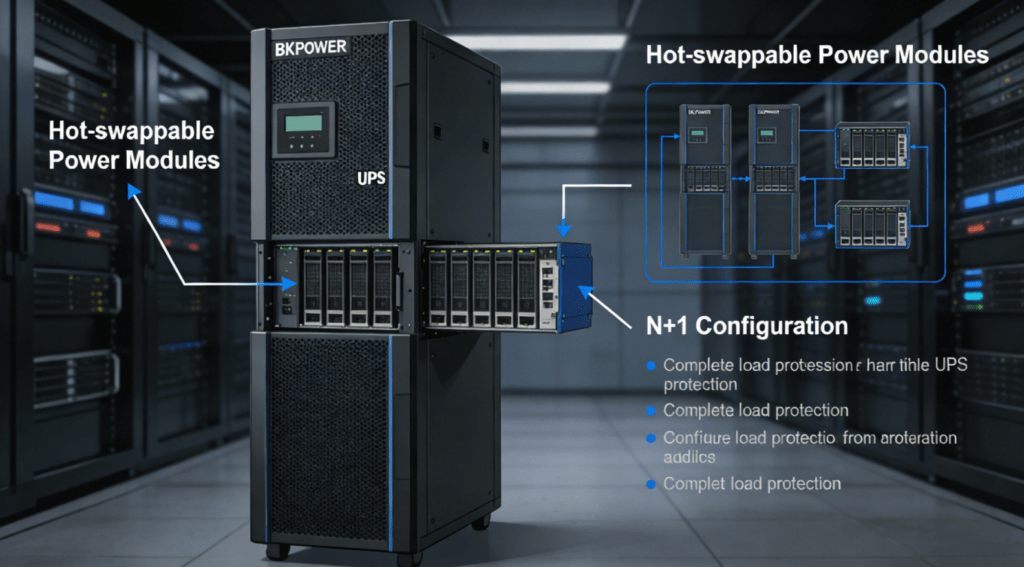
Figure 1: BKPOWER modular UPS architecture showing hot-swappable power modules. The N+1 configuration allows any single module removal while maintaining full load protection.
Ⅱ. Understanding Modular UPS Architecture
1. The Modular Design Philosophy
Traditional UPS systems use monolithic construction. One large power module handles the entire load. If that module fails, the system fails. Repairs require complete shutdown. Technicians must disassemble major components. This process takes hours or days.
Modular industrial UPS reverses this paradigm. Multiple smaller power modules share the load. Each module typically ranges from 10kW to 50kW capacity. The frame accepts a variable number of modules. A fully populated system might contain five 20kW modules for 100kW total capacity.
This architecture provides inherent redundancy. Systems configure as N+1 or N+X. N represents the capacity required for the load. The +X represents extra modules for fault tolerance. A 100kW load might use six 20kW modules (N=5, +1). If any single module fails, five remaining modules handle the full load.
Online industrial UPS operation ensures continuous protection. The double-conversion topology isolates loads from utility power fluctuations. Rectifiers convert AC to DC. Inverters convert DC back to clean AC. Modular systems distribute these functions across independent units.
2. The Hot-Swappable Mechanism
Hot-swappable power modules connect through sophisticated backplane systems. Blind mating connectors align automatically as technicians slide modules into the chassis. These connectors handle power, control signals, and communication buses.
Safety systems protect personnel and equipment during hot-swap operations. Mechanical interlocks prevent improper insertion. Electronic controls verify module compatibility before energizing. Soft-start circuits eliminate inrush currents when connecting new modules.
The process requires no tools. Front-access designs allow replacement from the aisle. Technicians need not access rear panels or cable connections. A single person can complete module replacement in under ten minutes.
Synchronization occurs automatically. New modules match voltage, frequency, and phase angle with operating modules. The parallel bus shares load proportionally. No manual adjustment or calibration is required.
3. Scalability Without Shutdown
Facilities grow. Power requirements increase. Traditional UPS systems force difficult choices. Operators either oversize initially or replace entire systems later. Both options waste resources.
Modular industrial UPS eliminates this trade-off. Additional capacity requires only new module installation. An existing 60kW system expands to 80kW by inserting another 20kW module. The operation occurs while the system continues protecting loads.
This pay-as-you-grow model optimizes capital expenditure. Facilities purchase capacity for immediate needs. They expand incrementally as loads increase. No forklift upgrades. No system replacements. No downtime for expansion.
Ⅲ. Maintenance Transformation: From Hours to Minutes
1. MTTR Comparison Analysis
Mean Time To Repair directly impacts availability. Traditional monolithic UPS systems exhibit MTTR of 6 to 12 hours. Some repairs require days. Fault diagnosis consumes time. Parts procurement adds delays. Disassembly and reassembly demand skilled labor.
Modular industrial UPS reduces MTTR to under 30 minutes. Many operations complete in 5 to 10 minutes. The difference is not incremental. It is transformational.
Consider a typical failure scenario. A power module develops a fault. The system detects the anomaly. It isolates the affected module. The alarm notifies maintenance personnel. The technician arrives at the equipment. The modular system continues operating with reduced redundancy.
The technician opens the front door. They release the faulty module using thumb latches. The module slides out on guide rails. It weighs perhaps 15 kilograms. One person handles it easily. The spare module inserts in seconds. Latches secure it automatically. The system recognizes the new module. It synchronizes and shares load. The entire process takes eight minutes.
The failed module travels to a repair depot. Technicians diagnose it at their convenience. The facility maintains operation throughout. No downtime occurs. No bypass operation is necessary.
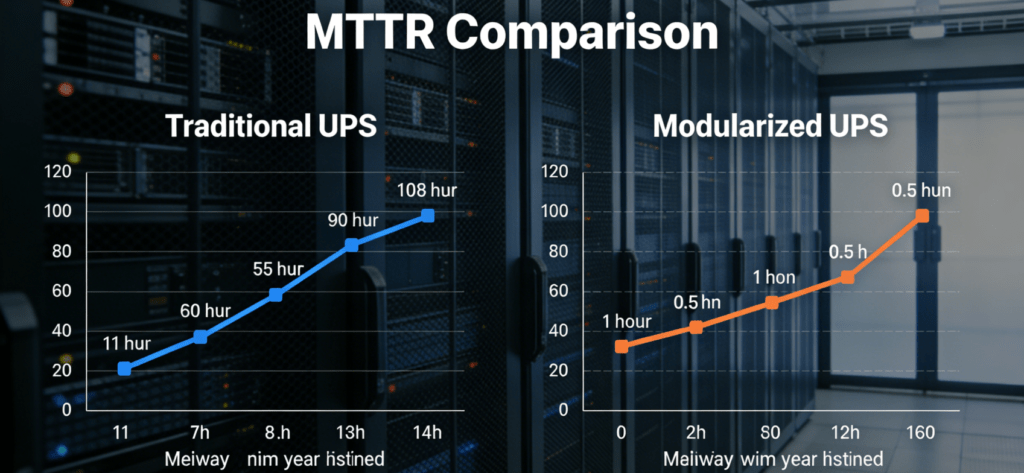
Figure 2: MTTR comparison showing modular UPS reduces repair time from 11 hours to under 1 hour. Annual downtime drops from 14 hours to 0.5 hours.
2. Elimination of Maintenance Bypass Operations
Traditional UPS maintenance requires bypass mode. Critical loads connect directly to utility power. They lose UPS protection during service. This vulnerability lasts for the entire maintenance duration. For major repairs, this could be hours or days.
Some facilities lack bypass capability. They must schedule maintenance during planned shutdowns. This constraint limits flexibility. It complicates preventive maintenance programs.
Modular industrial UPS eliminates these constraints. Individual modules shut down independently. Remaining modules continue providing conditioned power. Loads never see utility power directly. They never lose protection.
This concurrent maintainability proves especially valuable for critical applications. Hospitals cannot schedule patient care around UPS maintenance. Financial trading floors cannot pause for service windows. Industrial processes cannot tolerate unprotected power exposure.
Online industrial UPS systems with modular design solve these challenges. Maintenance occurs during normal operations. No special scheduling is required. No risk windows are created.
3. Reducing Planned Downtime
Preventive maintenance ensures long-term reliability. Traditional UPS systems require regular servicing. Capacitors age. Fans wear. Batteries require testing. These procedures typically necessitate downtime.
Modular architecture distributes these maintenance tasks. Fans reside in individual modules. Capacitors belong to specific power stages. Technicians service these components module by module. The system maintains full capacity from remaining units.
Battery maintenance also benefits. Modular UPS systems often use distributed battery configurations. Individual battery strings or modules can be tested, replaced, or upgraded without affecting system operation. This capability extends to lithium-ion battery systems, which require different management than traditional VRLA batteries.
The result is near-elimination of planned downtime. Facilities achieve 99.999% availability or better. The fifth nine becomes economically achievable through modular design.
Ⅳ. Operational and Economic Benefits
1. Total Cost of Ownership Optimization
Initial purchase price represents only part of UPS lifecycle cost. Energy consumption, maintenance, and downtime costs dominate long-term economics. Modular industrial UPS optimizes all these factors.
Right-sizing capacity prevents inefficiency. Traditional systems often run at 30-40% load for years after installation. Low loading reduces efficiency significantly. Modular systems ratchet capacity to match actual loads. Efficiency remains high across the operating range.
MTTR reduction saves indirect costs. Downtime avoidance preserves production revenue. It prevents equipment damage from unprotected power transitions. It eliminates overtime costs for emergency repairs.
End-of-life management also improves. Modular systems upgrade gradually. Individual modules can be replaced with newer technology. The frame and infrastructure persist. This “forever young” concept extends system lifespan indefinitely.
2. Staffing and Service Efficiency
Modular replacement requires less specialized skill than traditional UPS repair. Technicians swap standardized modules. They need not diagnose complex electronic faults. They need not perform delicate soldering operations. Basic training suffices for most maintenance tasks.
Inventory management simplifies. Facilities stock spare modules rather than individual components. One spare module can replace any unit in the system. This universality reduces spare parts inventory. It eliminates cross-referencing multiple part numbers.
Vendor support also streamlines. Replacement modules ship overnight from regional depots. Remote diagnostics identify faulty units before technicians arrive. The combination of modular design and modern logistics creates GPS-like precision in maintenance operations.
3. Risk Mitigation Through Redundancy
N+X redundancy provides fault tolerance beyond simple component reliability. The +X represents spare capacity that activates automatically when primary modules fail. This architecture tolerates multiple simultaneous faults, depending on the X value.
Traditional parallel redundancy requires complete Sistema UPS duplication. Two 100kW systems provide 100kW protected capacity with 100% redundancy. This 2N configuration costs significantly more than N+1 modular approaches.
Modular N+1 achieves similar protection at lower cost. Six 20kW modules provide 100kW load protection with one redundant module. The redundancy ratio is 17% rather than 100%. Yet the availability often exceeds traditional 2N configurations due to reduced complexity and faster repair.
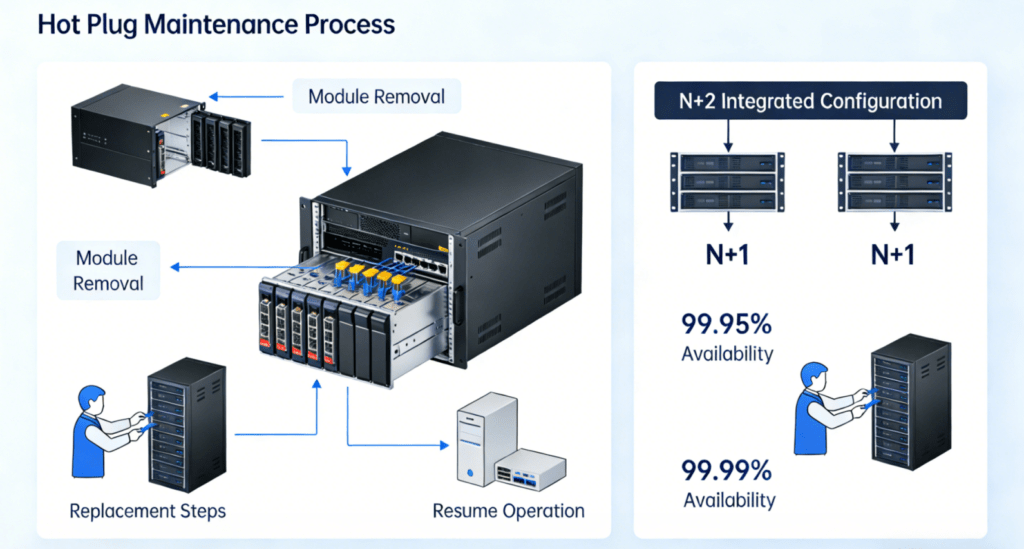
Figure 3: Hot-swap maintenance workflow and N+X redundancy configurations. N+1 and N+2 setups provide 99.99% and 99.999% availability respectively.
Ⅴ. Implementation Considerations
1. Sizing and Configuration Guidelines
Proper sizing ensures modular benefits realization. Oversizing wastes capacity. Undersizing threatens redundancy. System designers must analyze current and future loads carefully.
The N+X calculation requires load analysis plus growth projections. For a 60kW facility with 20% growth expected, N equals 72kW. Adding one 20kW module creates N+1 redundancy at 80kW total. This configuration handles the failing module plus some growth.
Frame selection considers maximum future capacity. A 200kW frame might initially house four 20kW modules. Later expansion fills empty slots. Eventually, parallel frames can be added horizontally. This vertical and horizontal scalability accommodates virtually unlimited growth.
2. Integration with Existing Infrastructure
Modular online industrial UPS integrates with current power distribution. Input and output switchgear remain unchanged. Neutral and grounding configurations stay consistent. The modular system replaces monolithic predecessors in the same footprint.
Many modular systems offer smaller footprints than equivalent monolithic units. High-density packaging squeezes more power into less space. This compactness frees valuable floor space for revenue-generating equipment.
Battery integration also flexes. Modular UPS accepts various battery technologies. Traditional VRLA, lithium-ion, or supercapacitors all work within the modular framework. Battery modules themselves can be hot-swappable in some designs.
Ⅵ. Conclusão
The transition from monolithic to modular industrial UPS represents a fundamental evolution in power protection. BKPOWER modular designs deliver on the promise of true continuous operation. Hot-swappable power modules transform maintenance from a system vulnerability into a routine convenience.
Online industrial UPS technology ensures loads never see raw utility power. The double-conversion process eliminates voltage transients, frequency variations, and power quality issues. Modular architecture extends these protections through maintenance events that previously required bypass operation.
MTTR reduction from hours to minutes changes availability calculations. Systems achieve five-nines reliability (99.999% uptime) or better. The economics of modular ownership favor scalability, efficiency, and longevity over traditional fixed-capacity approaches.
For facilities where downtime is not an option, modular industrial UPS provides the answer. Manufacturing continuity, process control integrity, and critical infrastructure protection all benefit from this advanced architecture. The question is no longer whether to adopt modular technology, but how quickly facilities can transition to realize these compelling advantages.
Referências
- Comissão Eletrotécnica Internacional (CEI)Sítio Web oficial: www.iec.ch
- Underwriters Laboratories (UL)Sítio Web oficial: www.ul.com
- Comité Europeu de Normalização (CEN)Sítio Web oficial: www.cen.eu
- Administração da Normalização da China (SAC)Sítio Web oficial: www.sac.gov.cn
- Aliança Tecnológica da Indústria de Armazenamento de Energia de Zhongguancun (CNESA)Sítio Web oficial: www.cnESA.org
- Organização Internacional de Normalização (ISO)Sítio Web oficial: www.iso.org