Bem-vindo à BKPOWER!












O que significa UPS?
TIPS:UPS stands for Uninterruptible Power Supply, a critical component of modern sistemas de energia de reserva that safeguards your electronics during power disruptions. This comprehensive guide explores double conversion UPS technology and UPS on-line systems, helping you understand how Sistemas UPS protect critical infrastructure from data centers to medical facilities. Whether you need a tower UPS for your office or an industrial-grade solution, discover the right UPS power protection strategy for your specific requirements.

In our increasingly digital world, power stability directly impacts business operations and data security. When the grid fails, voltage sags, or harmonic interference occurs, unprotected critical equipment faces risks of data loss, hardware damage, and operational downtime. This is where UPS (Uninterruptible Power Supply) systems play a crucial role.
A UPS is far more than a backup battery. It is a comprehensive power quality management system. By continuously monitoring grid conditions and responding to electrical anomalies within milliseconds, UPS systems deliver clean, stable power to connected devices. From home offices to large data centers, from medical equipment to industrial automation systems, UPS power solutions have become indispensable components of modern electrical infrastructure.

1. Understanding UPS: Definition and Working Principles
An Uninterruptible Power Supply is an electrical device that integrates energy storage (typically batteries) with power conversion circuitry. Its core function is to provide power conditioning and filtering when mains power is normal, and instantly switch to battery power during failures, ensuring zero or minimal interruption to critical loads.
The UPS operating mechanism involves three critical stages:
Normal Operation Phase: When utility power is stable, the UPS converts AC power to DC to charge batteries while delivering processed, clean AC power to connected loads. UPS on-line (Double Conversion UPS) continuously performs AC-DC-AC double conversion, completely isolating loads from grid disturbances.
Power Anomaly Detection Phase: Built-in microprocessors continuously monitor input voltage, frequency, and waveform parameters. Upon detecting voltage sags, surges, outages, or frequency deviations, the system immediately initiates protection protocols.
Energia de reserva Transition Phase: Depending on UPS topology, transfer times range from 0 milliseconds (online) to 2-10 milliseconds (standby). Once switched, loads receive power from batteries through inverters, ensuring continuous operation.
2. Three Main UPS Topologies Explained
Understanding UPS classifications is essential for proper selection. Currently, three primary UPS topologies dominate the market, each with unique applications and technical characteristics.
2.1 Standby UPS (Offline UPS)
Standby UPS represents the most basic and cost-effective UPS type. During normal operation, loads connect directly to utility power while the UPS performs simple monitoring and battery charging. When power failure or severe voltage anomalies are detected, a relay transfers the load to battery inverter power within 2-10 milliseconds.
Applications: Personal computers, small office equipment, network routers, and non-critical devices tolerant of brief transfer times.
Limitations: No voltage regulation capability, power interruption during transfer, limited protection for sensitive electronics.
2.2 Line-Interactive UPS
Line-interactive UPS adds Automatic Voltage Regulation (AVR) to the standby design. Through transformer tap switching or buck-boost circuits, it can correct voltage fluctuations within ±15% range without engaging batteries. When complete power loss occurs, transfer time to battery power is typically 2-4 milliseconds.
Technical Advantages: Higher efficiency (usually 90-95%), reduced battery usage extending battery life, moderate cost positioning.
Best Applications: SMB server rooms, network switching equipment, POS systems, VoIP communication devices requiring moderate power protection levels.
2.3 Online Double-Conversion UPS
Online double-conversion UPS provides the highest level of power protection, making it the preferred choice for mission-critical applications. In this architecture, utility power is always converted to DC, then reconverted to clean AC power for the load. Batteries remain online continuously, eliminating transfer time (0ms switchover).
Core Technical Advantages:
- Complete isolation from grid disturbances (harmonics, voltage fluctuations, frequency deviations)
- Output voltage precision up to ±1-2%
- Purest sine wave output quality
- Zero transfer time for truly seamless switching
Critical Application Areas: Data centers, hospital operating rooms, financial trading systems, industrial automation control systems, telecommunications infrastructure—any environment where power interruption is unacceptable.

3. UPS vs Alternative Backup Power Solutions
Understanding differences between UPS and alternative solutions enables informed decision-making.
3.1 UPS vs Portable Power Stations
Portable power stations have gained popularity for outdoor and emergency applications. Key differences include:
Design Philosophy: Portable power emphasizes mobility and versatility, featuring multiple output interfaces (USB, AC, DC) suitable for camping and outdoor work. UPS systems are designed for fixed installation, optimized for transfer speed and power quality.
Transfer Speed: UPS transfer times are measured in milliseconds (0-10ms), while portable power stations typically require tens of milliseconds or longer to activate inverters—unsuitable for protecting sensitive electronic equipment.
Capacity and Power: Portable power stations usually have limited capacity (300Wh-2000Wh), suitable for powering small devices for hours. UPS systems range from hundreds of VA to multiple MVA based on load requirements, with expandable battery options for extended runtime.
Application Boundaries: Portable power suits phones, laptops, and small appliances; UPS is essential for servers, medical equipment, and network infrastructure.
3.2 UPS vs Generators
Generators and UPS often work together in backup power systems but serve different functions:
Response Speed: UPS provides instantaneous (millisecond-level) power protection, while generators require 10-30 seconds from startup to stable power delivery. Thus, UPS handles “seamless transition” while generators provide “long-term supply.”
Power Quality: Modern online UPS delivers pure sine wave output with superior voltage and frequency stability compared to most portable generators.
Maintenance Requirements: UPS requires periodic battery replacement (typically 3-5 years) but minimal daily maintenance. Generators need fuel reserves, regular exercise cycles, oil changes, and more complex maintenance procedures.
Cost Structure: UPS involves higher initial investment but lower operating costs; generators incur ongoing fuel costs with noise and emission concerns.
3.3 UPS vs PC Power Supply (PSU)
PC power supplies are internal computer components converting AC mains to DC voltages required by components. They complement rather than replace UPS:
Protection Hierarchy: PSUs provide basic voltage conversion with limited protection against grid fluctuations and surges. UPS provides front-end protection for the entire system, including the PSU.
Functional Positioning: PSUs are “power converters”; UPS systems are “power protection systems.” Without UPS protection, PSUs and connected devices face damage risks during grid anomalies.
Synergistic Operation: Quality UPS paired with good PSUs significantly extends hardware lifespan and reduces data corruption risks.
4. Key Advantages and Limitations of UPS Systems
4.1 Core Advantages
Data and Hardware Protection: UPS primary value lies in preventing data loss and hardware damage from power interruptions. For servers or workstations performing critical tasks, UPS provides a “safe shutdown window” (typically 5-30 minutes) allowing users to save work and shut down systems orderly.
Power Quality Optimization: Especially double-conversion UPS, which filters grid harmonics, voltage spikes, and electromagnetic interference, providing medical-grade clean power for sensitive equipment. Critical for precision instruments, medical imaging equipment, and laboratory devices.
Business Continuity Assurance: In data centers, financial institutions, and medical facilities, even brief power interruptions can cause millions in losses or endanger lives. UPS ensures these critical facilities continue operating during grid failures.
Equipment Lifespan Extension: By providing stable voltage and frequency, UPS reduces electrical stress on electronic devices, extending equipment lifespan and lowering Total Cost of Ownership (TCO).
4.2 Limitations and Considerations
Initial Investment Cost: High-quality UPS systems, particularly online double-conversion types, involve significantly higher procurement costs than basic power protection solutions. Additionally, battery replacement (every 3-5 years) increases long-term operating costs.
Energy Efficiency Considerations: Double-conversion UPS, due to continuous AC-DC-AC conversion, typically achieves 90-95% efficiency, slightly lower than line-interactive UPS (95-98%). In large deployments, this creates additional cooling and power costs.
Physical Space Requirements: High-power UPS systems and associated battery banks require dedicated room space, with considerations for load-bearing capacity, ventilation, and temperature/humidity control.
Battery Disposal: UPS batteries (traditional lead-acid or lithium-ion) require professional recycling at end-of-life, involving environmental compliance costs.
5. Industry-Specific UPS Applications
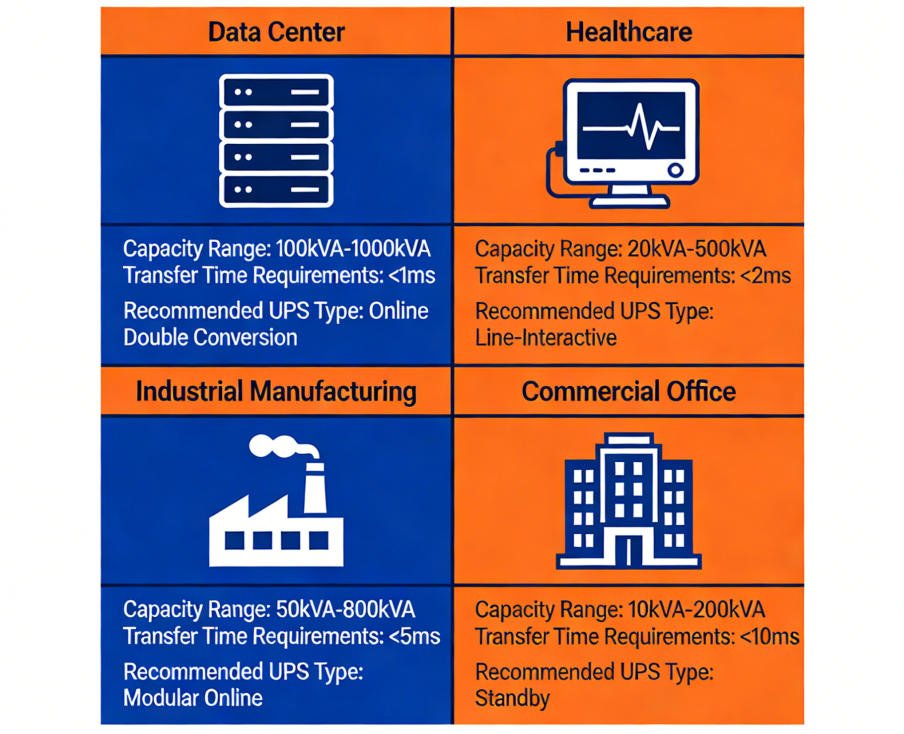
5.1 Data Centers and IT Infrastructure
Data centers represent the most demanding UPS application environments. Modern facilities employ layered protection strategies:
Rack-Level Protection: Each server rack equipped with rack-mounted UPS (1-10kVA capacity) providing final power defense.
Room-Level Protection: Large online UPS systems (100kVA to multiple MVA) provide centralized protection for entire rooms or zones, typically using N+1 or 2N redundant configurations for maximum availability.
Cloud and Edge Computing: As edge computing nodes deploy to remote locations, industrial-grade UPS must operate reliably in harsh environments (high temperature, humidity, dust).
Critical Metrics: Data center UPS requires zero transfer time, >96% efficiency (using ECO mode or modular design), hot-swappable maintenance support, intelligent monitoring, and predictive maintenance capabilities.
5.2 Healthcare and Life Sciences
Medical environments demand UPS capabilities beyond simple backup power, involving patient safety:
Operating Rooms and ICU: Life support equipment (ventilators, heart-lung machines, anesthesia systems) must have online double-conversion UPS ensuring uninterrupted power under any circumstances. Typically requires 0ms transfer time and minimum 30-minute backup duration.
Medical Imaging Equipment: CT, MRI, and DSA equipment are extremely sensitive to power quality; voltage fluctuations can cause image artifacts or equipment damage. UPS must provide pure sine wave with Total Harmonic Distortion (THD) <3%.
Hospital Information Systems: HIS, PACS, and electronic medical record servers and storage require UPS protection to prevent data loss and system crashes.
Regulatory Requirements: Medical equipment UPS typically must comply with IEC 60601-1 medical safety standards, featuring isolation transformers and leakage current protection.
5.3 Industrial Automation and Manufacturing
Industrial environments present unique UPS challenges:
Motor and Cargas indutivas: Industrial UPS must withstand high inrush currents during motor startup (typically 3-7 times rated current) and provide sufficient overload capacity.
Harsh Environment Adaptation: Factory dust, oil, vibration, and extreme temperatures require UPS with high protection ratings (IP54 or higher) and wide temperature operating ranges (-20°C to 50°C).
Process Control Systems: PLC, DCS, and SCADA system UPS often require extremely long backup durations (hours), typically used with generators where UPS handles seamless transition.
Power Quality Management: Industrial UPS often doubles as active filters, compensating for grid harmonics and improving fator de potência.
5.4 Commercial Buildings and Smart Facilities
Modern intelligent buildings rely on UPS to protect critical systems:
Security and Fire Safety: Surveillance cameras, access control systems, and fire alarm controllers must have UPS ensuring continuous operation during emergencies. Regulations often require minimum 24-hour backup duration.
Communications and Network Infrastructure: Building Automation Systems (BAS), elevator control systems, and smart lighting controller network switches and controllers require UPS protection.
Retail and Finance: POS systems, ATMs, and trading terminal UPS require compact designs suitable for under-counter installation with sufficient outlet interfaces.
6. How to Select the Right UPS for Your Needs
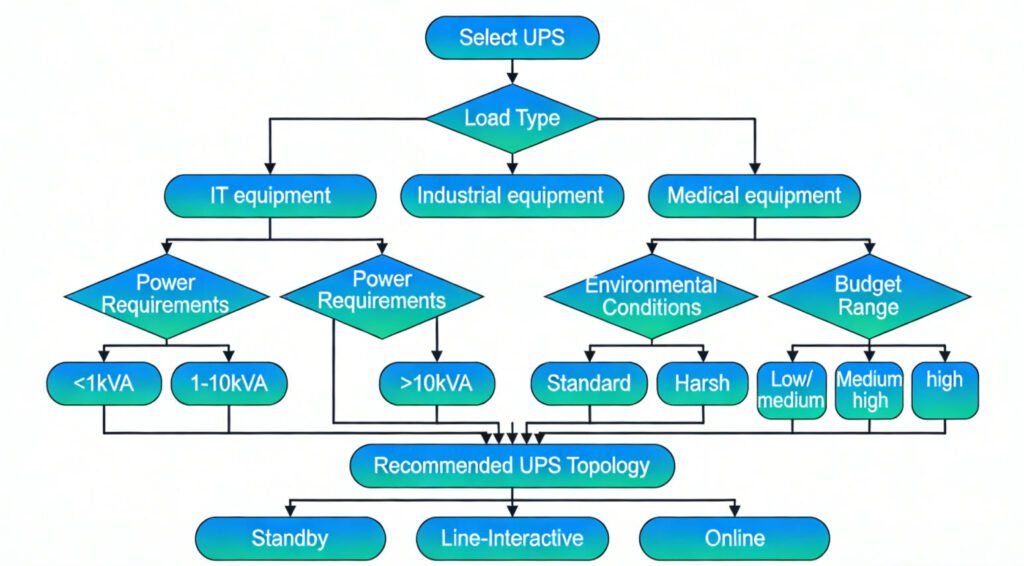
Proper UPS selection requires a systematic approach:
Step 1: Load Assessment
- List all equipment requiring protection with rated power (W or VA)
- Calculate total power requirements with 20-30% headroom
- Identify special load types (motors, transformers, capacitive loads)
Step 2: Determine Backup Duration
- Short-term backup (5-15 minutes): Allows safe shutdown
- Medium-term backup (30 minutes-2 hours): Awaits generator startup or short-term independent operation
- Long-term backup (>2 hours): Requires large battery banks or alternative energy sources
Step 3: Select Topology
- Non-critical equipment: Standby UPS
- SMB IT: Line-interactive UPS
- Mission-critical applications: Online double-conversion UPS
Step 4: Consider Scalability
- UPS modular allows power module additions as business grows
- Expandable battery banks support extended backup duration
- Redundant configurations (N+1) improve system availability
Step 5: Evaluate Total Cost of Ownership (TCO)
- Initial procurement cost
- Battery replacement cycles and costs (typically 30-40% of TCO)
- Energy costs (efficiency differences)
- Maintenance and service costs
7. Future Trends in UPS Technology
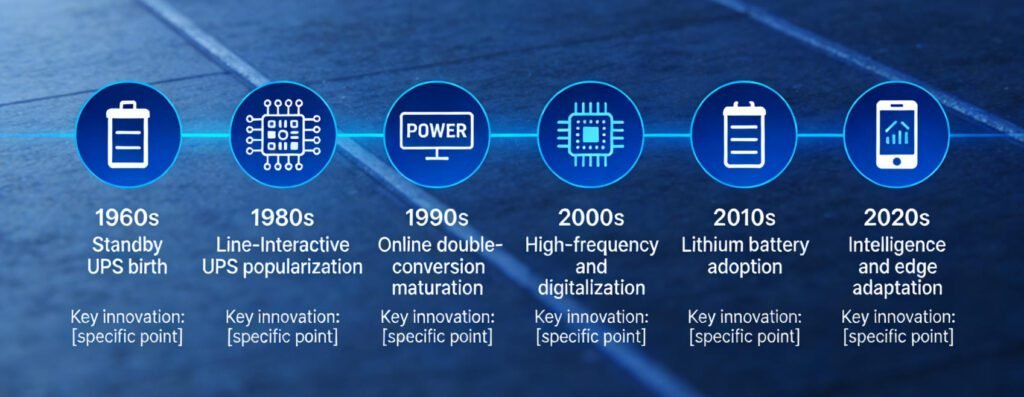
As energy transition and digitalization accelerate, UPS technology undergoes significant transformation:
Lithium Battery Revolution: Lithium-ion batteries are replacing traditional lead-acid batteries, offering longer lifespan (10-15 years vs 3-5 years), smaller footprint, lighter weight, and faster charging. Higher initial costs are offset by TCO advantages.
Intelligence and Connectivity: IoT technology enables UPS with monitoramento remoto, predictive maintenance, and AI optimization capabilities. Through cloud platforms, operators can monitor global UPS fleet health in real-time.
Energy Management Integration: Modern UPS functions not just as backup power but as smart grid participants. Through demand response, time-of-use optimization, and renewable energy integration, UPS helps users reduce energy costs and improve sustainability.
Modularity and Scalability: Modular UPS architecture allows capacity expansion on demand, reducing initial investment, improving maintenance convenience (hot-swappable modules), and achieving higher availability (automatic fault module isolation).
Edge Computing Adaptation: For distributed edge data centers, new-generation UPS must adapt to wider temperature ranges, higher altitudes, smaller physical sizes, and support distributed energy sources like solar or wind power.
8. Conclusion: Investing in UPS Means Investing in Business Continuity
In an increasingly power-dependent world, UPS systems have evolved from “optional accessories” to “critical infrastructure.” Whether protecting single workstation data or ensuring entire data center operations, selecting the appropriate UPS system represents wise risk management investment.
Understanding different UPS topologies, application scenarios, and technology trends helps you make decisions aligned with actual requirements. Remember, the most expensive UPS is not necessarily the best—the optimal choice is the one that best fits your specific application needs.
As a professional power protection manufacturer, BKPOWER offers a comprehensive range of UPS solutions from standby to online double-conversion, covering 1kVA to 800kVA power ranges to meet demanding requirements across industries and applications. Our technical team stands ready to provide professional selection consultation and customized solutions.
Contact BKPOWER today to build an unbreakable power defense line for your critical equipment.

Referências
- Comissão Eletrotécnica Internacional (IEC)Site oficial: www.iec.ch
- Underwriters Laboratories (UL)Site oficial: www.ul.com
- Comitê Europeu de Padronização (CEN)Site oficial: www.cen.eu
- Administração de Padronização da China (SAC) Site oficial: www.sac.gov.cn
- Zhongguancun Energy Storage Industry Technology Alliance (CNESA)Site oficial: www.cnESA.org
- Site oficial da International Organization for Standardization (ISO): www.iso.org