Welcome to BKPOWER!







.png)
.png)

Principles & Comparison of Line-Interactive/Online/Offline UPS
TIPS:This article focuses on two core power protection devices: UPS systems and voltage stabilizers, systematically analyzing the working principles and functional differences of three types of UPS systems (line-interactive, online, and offline), while clarifying the key role of voltage stabilizers (such as AC voltage stabilizers and contactless voltage stabilizers) in voltage regulation. By comparing the switching time, voltage accuracy, and applicable scenarios of the three UPS systems, and combining the complementary characteristics of voltage stabilizers, it provides professional selection references for different demand scenarios (from home offices to data centers), helping readers understand how to build a comprehensive power protection solution through the coordinated use of UPS systems and voltage stabilizers.

An Uninterruptible Power Supply (UPS)—also widely referred to as a UPS system or UPS power supply—is an electrical system designed to provide emergency power to loads when the input power source or mains power fails. It serves as near-instantaneous protection against input power outages, ensuring critical equipment remains operational. In the modern power protection landscape, UPS systems are primarily categorized into three types: Line-interactive UPS, Online UPS, and Offline UPS (all falling under the broader term UPS supplies). While UPS systems focus on continuous power during outages, they often work in tandem with Voltage stabilizers (such as Power voltage stabilizers, AC voltage stabilizers, or Automatic voltage stabilizers) to address voltage fluctuations—a key distinction in power protection solutions. This article conducts a detailed analysis and comparison of these three UPS system types from the perspectives of working principles, core functions, advantages, disadvantages, and applicable scenarios, while integrating key industry terms to provide professional guidance for model selection.
I. Working Principles of the Three Types of UPS Systems
1. Offline UPS – Entry-Level UPS Power Supply for Basic Protection
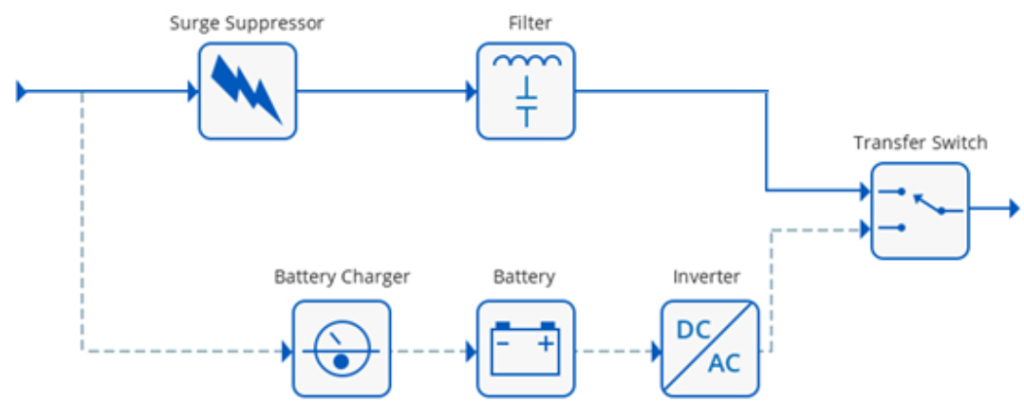
Offline UPS, commonly called “standby UPS,” is a cost-effective UPS power supply where the load is directly powered by the mains during normal operation. Critical components of the UPS system—including the battery charger, battery, and inverter (a device that converts DC to AC, distinct from standalone Inverters used for general power conversion)—remain in an “offline” standby state.
The specific workflow is as follows: When mains power is stable, the charger stays connected to the mains to keep the battery fully charged, ensuring readiness for emergencies. If the mains voltage fails (e.g., a blackout) or exceeds preset limits (typically ±15% to ±20% of the rated voltage), the built-in transfer switch activates immediately. This switch redirects the power path to the inverter, which converts DC power from the battery to AC power to supply critical loads. Unlike Voltage stabilizers (such as Servo motor voltage stabilizers that adjust voltage dynamically), offline UPS does not regulate voltage during normal operation—it only intervenes when the mains fails.
2. Line-Interactive UPS – Mid-Tier UPS System with Voltage Regulation
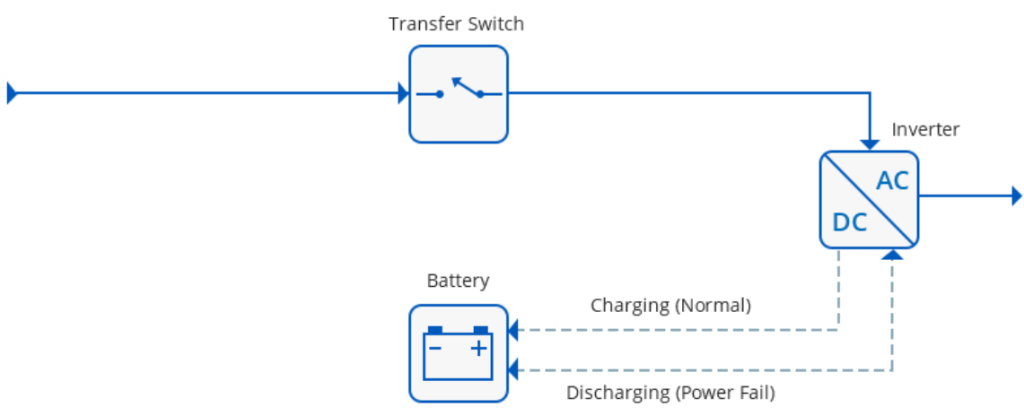
Line-interactive UPS is a versatile UPS power supply that combines basic outage protection with limited voltage adjustment capabilities—bridging the gap between simple offline UPS and advanced online UPS. A defining feature of this UPS system is that its inverter remains “online” at all times, allowing it to switch between charging and power supply modes flexibly.
When mains power is normal, the inverter operates in reverse: instead of powering the load, it acts as a charger to maintain the battery’s charge. This design not only ensures quick response to outages but also enables basic voltage correction, similar to a simplified Automatic voltage stabilizer. If the mains voltage drops (undervoltage) or rises (overvoltage) within a certain range, the UPS uses a built-in autotransformer to adjust the voltage—avoiding unnecessary battery activation. When a complete mains failure occurs, the transfer switch rapidly cuts the charging circuit, and the inverter switches to forward mode, converting battery DC power to AC power for the load. This UPS power supply is more adaptable than offline UPS but lacks the precision of dedicated Voltage stabilizers (e.g., Contactless voltage stabilizers or Non-contact Voltage Stabilizers that adjust voltage without mechanical parts).
3. Online UPS – Premium Uninterruptible Power Supply for Critical Loads
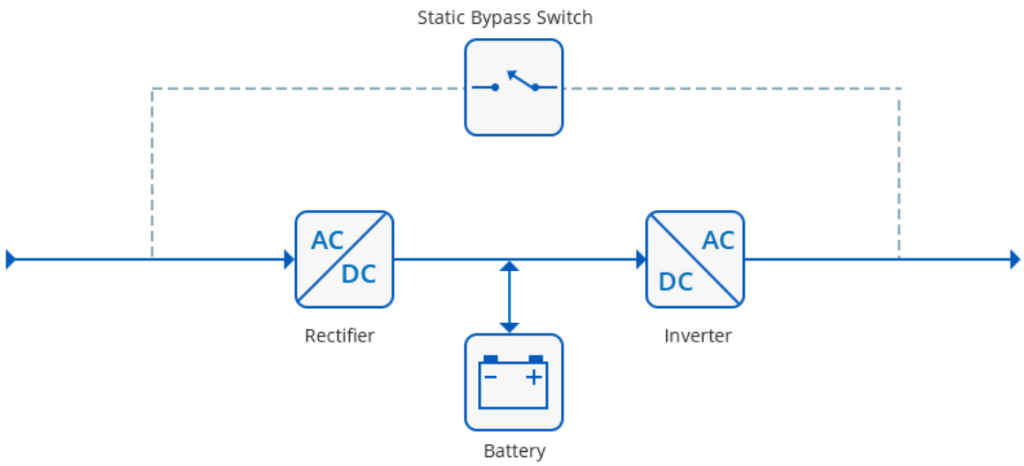
Online UPS (also called “double-conversion UPS”) is the most advanced UPS system, designed to deliver “clean, continuous power” for mission-critical equipment. This Uninterruptible Power Supply uses a “double-conversion” process—AC → DC → AC—to isolate the load completely from mains fluctuations, making it far more reliable than both offline and line-interactive UPS.
The workflow of this UPS power supply has two key stages: First, the rectifier converts incoming AC power to DC power. Part of this DC power charges the backup battery, while the rest is sent directly to the inverter. Second, the inverter converts the stable DC power back to standard AC power (e.g., 120V/230V) to supply the load. Unlike other UPS types, online UPS never uses the mains directly—even when it is stable. This means there is zero switching time during a mains failure: the battery simply takes over powering the inverter, ensuring no interruption. For critical environments like data centers or hospitals, this UPS system is often paired with high-precision Voltage stabilizers (such as AC voltage stabilizers) to further enhance power quality, though the UPS itself already provides superior voltage regulation compared to most standalone stabilizers.
II. Core Function Comparison of the Three UPS Systems
While all three UPS system types protect against power outages, their performance varies significantly in areas like surge protection, voltage regulation, and response speed—especially when compared to Voltage stabilizers and standalone Inverters. The following is a detailed comparison:
1. Surge and Noise Protection (vs. Voltage Stabilizers)
All three UPS power supply types include basic surge suppression and line noise filtering to shield equipment from lightning-induced surges, electromagnetic interference (EMI), and radio-frequency interference (RFI). However:
- Offline UPS: Offers only basic protection. During normal operation, the load is directly connected to the mains, so it may still be affected by high-frequency noise or transient surges—unlike Contactless voltage stabilizers that filter noise continuously.
- Line-Interactive UPS: Provides enhanced filtering thanks to its always-online inverter, reducing noise more effectively than offline UPS but not as thoroughly as dedicated Power voltage stabilizers.
- Online UPS: Delivers complete protection. Its double-conversion process isolates the load from the mains entirely, filtering out all surges, noise, and harmonics—matching or exceeding the performance of high-end Voltage stabilizers.
2. Battery Switching Time (Critical for Power UPS Reliability)
Switching time—the delay between mains failure and battery activation—is a key metric for Power UPS effectiveness, especially for sensitive equipment:
- Offline UPS: Requires 2–10 ms to switch, as it relies on a mechanical transfer switch. This delay may cause data loss or shutdowns for devices like medical monitors.
- Line-Interactive UPS: Cuts switching time to 2–4 ms, as the inverter is already online. This is fast enough for most office equipment (e.g., servers) but not for ultra-sensitive industrial machinery.
- Online UPS: Has zero switching time—the inverter powers the load continuously, making it the only viable Uninterruptible Power Supply for critical systems like ICU medical devices or data center servers.
3. Voltage Regulation (vs. Dedicated Voltage Stabilizers)
Voltage regulation addresses undervoltage, overvoltage, and fluctuations—an area where UPS supplies differ greatly from Voltage stabilizers:
- Offline UPS: No active voltage regulation. It only uses the battery when voltage exceeds extreme limits, making it unsuitable for areas with unstable mains (unlike Servo motor voltage stabilizers that adjust voltage dynamically).
- Line-Interactive UPS: Uses Automatic Voltage Regulation (AVR) to adjust voltage within ±8%–15% of nominal. This reduces battery usage but is less precise than Automatic voltage stabilizers (which typically regulate to ±1%–5%).
- Online UPS: Achieves precise regulation (±2%–3% of nominal) via double conversion, also correcting frequency deviations (±0.1 Hz). This performance exceeds most AC voltage stabilizers, making it ideal for precision equipment.
4. Protection Against Common Power Issues
The table below compares how each UPS system handles typical power problems, alongside Voltage stabilizers for reference:
| Power Problem Type | Offline UPS | Line-Interactive UPS | Online UPS | Voltage Stabilizers (e.g., Contactless) |
|---|---|---|---|---|
| Mains Interruption | √ | √ | √ | × (No outage protection) |
| Voltage Sag (Undervoltage) | × | √ (AVR) | √ | √ (Precise adjustment) |
| Voltage Surge | √ (Basic) | √ (Advanced) | √ (Complete) | √ (High-end models) |
| Frequency Deviation | × | × | √ | × (No frequency correction) |
| Harmonic Distortion | × | × | √ | √ (Some models) |
| Line Noise (EMI/RFI) | √ (Basic) | √ (Advanced) | √ (Complete) | √ (Excellent) |
Note: “√” = Provides protection; “×” = No protection. UPS supplies focus on outage protection, while Voltage stabilizers specialize in voltage adjustment.
III. Advantages and Disadvantages of the Three UPS Systems
1. Offline UPS – Economical UPS Power Supply
Advantages
- High Efficiency: 95%–98% efficiency during normal operation, as only the charger works (lower energy waste than other UPS supplies).
- Low Cost: The most affordable Uninterruptible Power Supply type, ideal for budget-constrained users (e.g., home offices).
- Simple Operation: No complex setup—works out of the box, with minimal maintenance.
Disadvantages
- Limited Protection: No voltage regulation or frequency correction, making it unsuitable for unstable mains (unlike Non-contact Voltage Stabilizers).
- Slow Switching: 2–10 ms delay risks data loss for sensitive equipment.
- Load Exposure: Direct mains connection during normal operation leaves equipment vulnerable to surges and noise.
2. Line-Interactive UPS – Balanced UPS System
Advantages
- AVR Function: Reduces battery usage by adjusting voltage, extending battery life (a key advantage over offline Power UPS).
- Fast Switching: 2–4 ms response, suitable for most office and small business equipment.
- Moderate Cost: More affordable than online UPS, with better protection than offline models.
Disadvantages
- Capacity Limits: Typically 0.5–5 kVA—unsuitable for large loads (unlike high-capacity online UPS systems).
- No Frequency Correction: Fails to address frequency deviations, requiring pairing with Voltage stabilizers in some regions.
- Limited Harmonic Filtering: Cannot eliminate harmonics, which may disrupt precision equipment.
3. Online UPS – Premium Uninterruptible Power Supply
Advantages
- Zero Interruption: No switching delay, critical for life-saving or revenue-generating equipment.
- Superior Power Quality: Pure sine wave output (THD ≤3%) and precise regulation, exceeding most Voltage stabilizers.
- Full Protection: Shields against all power issues (surges, noise, harmonics, frequency deviations).
Disadvantages
- High Cost: Expensive initial investment and maintenance—up to 3x the cost of offline UPS.
- Lower Efficiency: 80%–90% efficiency due to continuous double conversion (higher energy bills).
- Large Size: Requires space for cooling systems, unlike compact Contactless voltage stabilizers or small UPS models.
IV. Applicable Scenarios for the Three UPS Systems
1. Offline UPS – Ideal for Basic UPS Supplies
- Target Users: Home users, SOHO (Small Office/Home Office), and budget-conscious small businesses.
- Typical Equipment: Personal computers, routers, printers, and small EPABX systems.
- Complementary Products: Pair with AC voltage stabilizers in areas with unstable mains to address voltage fluctuations.
2. Line-Interactive UPS – Suitable for Mid-Tier UPS Power Supply Needs
- Target Users: Small/medium enterprises (SMEs), department-level server rooms, and retail stores.
- Typical Equipment: Departmental servers, POS systems, and network switches.
- Complementary Products: Works with basic Power voltage stabilizers to enhance voltage regulation in poor grid areas.
3. Online UPS – Critical for High-End UPS Systems
- Target Users: Data centers, hospitals, financial institutions, and industrial facilities.
- Typical Equipment: ICU medical devices, database servers, industrial controllers, and CT scanners.
- Complementary Products: Often paired with Servo motor voltage stabilizers or Non-contact Voltage Stabilizers for ultra-stable power in harsh industrial environments.
V. Core Parameter Summary Table
| Parameter | Offline UPS | Line-Interactive UPS | Online UPS | Voltage Stabilizers (e.g., Automatic) |
|---|---|---|---|---|
| Power Range | 0–3 kVA | 0.5–5 kVA | 1–2000 kVA | Varies (0.5–1000 kVA) |
| Switching Time | 2–10 ms | 2–4 ms | 0 ms | N/A (No outage protection) |
| Voltage Regulation | None | ±8%–15% (AVR) | ±2%–3% | ±1%–5% (Precise) |
| Efficiency (Normal Mains) | 95%–98% | 90%–96% | 80%–90% | 95%–99% |
| Cost per VA | Low | Medium | High | Medium-High |
| Key Use Case | Home/SOHO | SMEs/Department Rooms | Data Centers/Hospitals | Industrial/Commercial Voltage Stability |
VI. Summary and Selection Guidelines
- Match to Load Requirements:
- For basic devices (e.g., home PCs), choose offline UPS supplies (cost-effective).
- For office servers or POS systems, select line-interactive UPS power supply (balances protection and cost).
- For critical equipment (e.g., medical devices), opt for online Uninterruptible Power Supply (zero risk of interruption).
- Consider Grid Conditions:
- In areas with unstable voltage, pair UPS with Voltage stabilizers (e.g., Contactless voltage stabilizers for low maintenance).
- In regions with frequent frequency deviations, only online UPS can provide reliable protection.
- Balance Cost and Value:
- Avoid overinvesting (e.g., using online UPS for home use) or underprotecting (e.g., using offline UPS for servers).
- Factor in long-term costs: Online UPS has higher upfront costs but lower downtime risks for critical operations.
By integrating UPS system capabilities with the voltage-regulating strengths of Voltage stabilizers, businesses can build comprehensive power protection solutions tailored to their unique needs.
References
- International Electrotechnical Commission (IEC)Official website: www.iec.ch
- Underwriters Laboratories (UL)Official website: www.ul.com
- European Committee for Standardization (CEN)Official website: www.cen.eu
- Standardization Administration of China (SAC)Official website: www.sac.gov.cn
- Zhongguancun Energy Storage Industry Technology Alliance (CNESA)Official website: www.cnESA.org
- International Organization for Standardization (ISO)Official website: www.iso.org