Welcome to BKPOWER!







.png)
.png)

Single vs Three Phase UPS/1 Phase vs 3 Phase UPS
Single vs Three Phase UPS OR 1 Phase vs 3 Phase UPS: Which One Powers Your Critical Infrastructure Best?
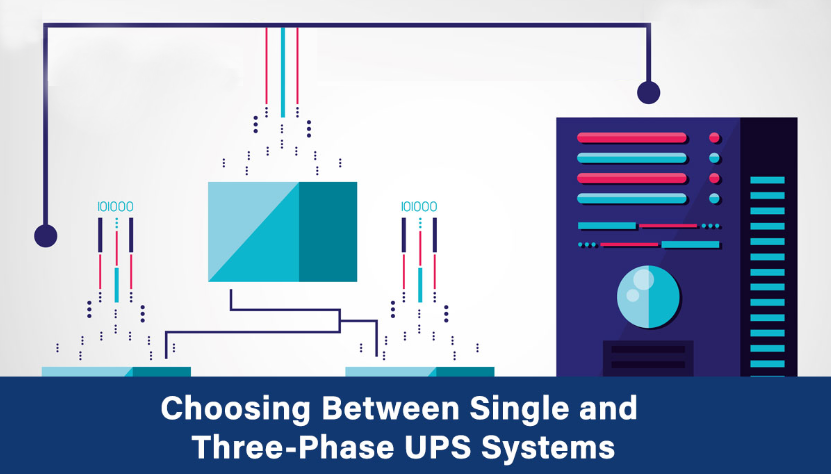
1. Understanding 1-Phase vs. 3-Phase Electricity
Before diving into UPS comparisons, it’s essential to grasp the fundamentals of electrical systems.
- Single-Phase/1-Phase Electricity
- Definition: Delivers power through two wires (phase and neutral) with a single alternating current waveform.
- Applications: Ideal for small-scale setups like residential homes, offices, or light commercial devices (e.g., computers, printers).
- Limitations: Voltage fluctuations under heavy loads and limited power capacity (typically up to 2.4 kW).
- Three-Phase/3-Phase Electricity
- Definition: Uses three interconnected wires to distribute power evenly, providing a stable and continuous current.
- Applications: Dominates industrial, commercial, and data center environments due to its ability to handle high loads (up to 100 kW+).
- Advantages: Reduced energy loss, improved efficiency, and compatibility with heavy machinery.
Visual Comparison:
| Aspect | Single-Phase/1-Phase | Three-Phase/3-Phase |
|---|---|---|
| Voltage | 120/240V | 208/480V |
| Power Capacity | Up to 2.4 kW | Up to 100+ kW |
| Efficiency | 75-85% | 90-95% |
| Ideal For | Small devices | Industrial, data centers |
2. Single vs. Three-Phase UPS: Key Differences
When selecting a UPS, the phase configuration directly impacts performance and reliability.
A. Technical Specifications
- Single-Phase/1-Phase UPS
- Pros: Cost-effective, compact, and simple to install.
- Cons: Limited scalability, prone to voltage spikes, and unsuitable for high-power devices.
- Three-Phase/3-Phase UPS
- Pros:
- Enhanced Stability: Balances load across three phases, minimizing downtime.
- Higher Efficiency: Reduces energy waste through optimized power distribution.
- Scalability: Supports dynamic power demands, ideal for growing businesses.
- Cons: Higher upfront cost and complex installation.
- Pros:
B. Application Scenarios
| Scenario | Recommended System | Why? |
|---|---|---|
| Home/Small Office | Single-Phase/1-Phase UPS | Sufficient for low-power devices. |
| Data Center | Three-Phase/3-Phase UPS | Ensures uninterrupted power for servers and cooling systems. |
| Manufacturing Plant | Three-Phase/3-Phase UPS | Handles heavy machinery and fluctuating loads. |
C. Performance in Power Outages
- Single-Phase/1-Phase UPS:
- Provides backup for 10–30 minutes, suitable for short-term outages.
- Risk of data loss during prolonged interruptions.
- Three-Phase/3-Phase UPS:
- Delivers 1–2 hours of backup with seamless transition to backup generators.
- Critical for mission-critical operations like hospitals or financial institutions.
3. Why Choose BKPOWER’s Three-Phase/3-Phase UPS Solutions?
BKPOWER redefines power reliability with its advanced 3-phase UPS systems, engineered for modern infrastructure needs.
A. Core Features
- Smart Power Management:
- Real-time monitoring via BKPOWER’s proprietary software (e.g., PowerChute™).
- Automatic load shedding to prioritize critical devices during outages.
- Energy Efficiency:
- Achieves 96% efficiency with Eco Mode, reducing operational costs by 20%.
- Scalability:
- Modular design allows seamless expansion from 10 kW to 1 MW.
B. Case Studies
- Data Center Success:
A leading cloud provider reduced downtime by 98% after deploying BKPOWER’s 3-phase UPS, ensuring 100% uptime for mission-critical servers. - Industrial Application:
A automotive manufacturing plant eliminated production halts by integrating BKPOWER’s UPS with solar arrays, cutting energy costs by 35%.
C. Technical Advantages
- Zero-Transfer Switching: Seamless transition between grid and battery power (<1 ms).
- Advanced Battery Tech: Lithium-ion batteries with 10-year lifespan and 99% recyclability.
4. The Future of Power: 3-Phase UPS Dominance
As industries evolve, 3-phase UPS systems are becoming the gold standard. Here’s why:
- Renewable Integration: Compatible with solar and wind energy, supporting sustainability goals.
- AI-Driven Optimization: Predictive analytics prevent outages and extend battery life.
BKPOWER’s Commitment:
We invest 20% of annual revenue in R&D to stay ahead of trends, ensuring our 3-phase UPS solutions meet tomorrow’s challenges.
5. Conclusion
Choosing between single-phase and 3-phase UPS hinges on your power needs. While single-phase suits small setups, 3-phase UPS from BKPOWER offer unmatched reliability, efficiency, and scalability for demanding environments.
Visit BKPOWER’s official site to explore our Three-Phase/3-Phase UPS lineup and request a free energy audit.
References
- International Electrotechnical Commission (IEC)Official website: www.iec.ch
- Underwriters Laboratories (UL)Official website: www.ul.com
- European Committee for Standardization (CEN)Official website: www.cen.eu
- Standardization Administration of China (SAC)Official website: www.sac.gov.cn
- Zhongguancun Energy Storage Industry Technology Alliance (CNESA)Official website: www.cnESA.org
- International Organization for Standardization (ISO)Official website: www.iso.org