Welcome to BKPOWER!












UPS vs Voltage Stabilizers: Core Differences, Technical Guide
Abstract:In the field of power protection equipment, UPS (Uninterruptible Power Supply) and voltage stabilizers (including Automatic Voltage Regulators (AVRs), Industrial Voltage Stabilizers, and Non-Contact Stabilizers) form a complementary technical ecosystem. This article provides an in-depth analysis of their core differences:

- Functional Positioning:
- UPS focuses on power outage protection and power purification (0ms switchover), integrating battery backup and harmonic mitigation.
- Voltage stabilizers specialize in dynamic voltage regulation (e.g., servo-based AVR with ±0.5% precision), covering ±30% wide-range compensation.
- Technical Architecture:
- UPS employs IGBT inverter + static bypass architecture (<10ms response).
- Non-contact stabilizers utilize Hall-effect sensors + magnetic coupling for zero mechanical wear.
- Application Scenarios:
- Data centers prioritize online UPS (N+1 redundancy).
- Industrial settings adopt contact/non-contact stabilizers, while precision instruments require SEMI F47-compliant devices.
Through technical parameter comparisons (input voltage range, overload capacity) and a selection matrix, this guide offers a comprehensive framework for optimizing cost efficiency and ensuring high availability from grid input to end-load protection.
I. Functional Positioning Comparison
| Dimension | UPS (Uninterruptible Power Supply) | Voltage Stabilizers |
|---|---|---|
| Core Function | 1. Battery Backup: Seamless power switching during outages 2. Eliminate voltage fluctuations/harmonic interference 3. Voltage/frequency stabilization (AVR integration) 4. Data protection & hardware compatibility optimization | 1. Dynamic Voltage Regulation: Industrial stabilizers (Industrial Voltage Stabilizers) compensate voltage deviations in real-time 2. Overvoltage/undervoltage protection 3. Contact vs. Contactless (Non-Contact) stabilization technologies |
| Operating Mode | Dual-mode operation: – Normal power: Rectifier → Inverter → Output (supports UPS system hot-swapping) – Power outage: Battery → Inverter → Output (zero-switching delay) | Single-mode operation: – Continuous voltage monitoring → Automatic adjustment (servo motor/non-contact magnetic coupling control) |
| Typical Applications | Data centers (UPS Power Systems), medical imaging, telecom base stations (zero downtime required) | Industrial motors (Industrial Voltage Stabilizers), commercial HVAC systems, precision instruments (paired with AVR regulators) |
II. Technical Architecture Differences
1. UPS (Uninterruptible Power System) Core Components
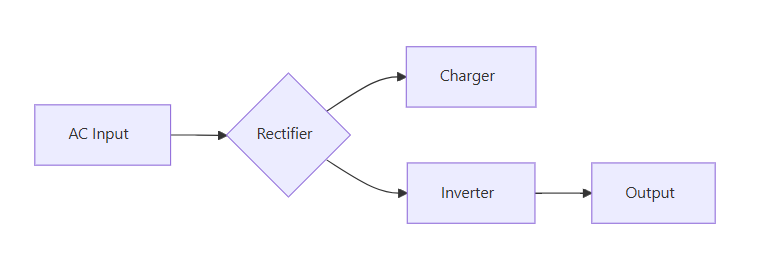
- Key Components: IGBT inverters, high-frequency PWM technology, static bypass switches
- Response Time: <10ms (online UPS)
- Critical Features:
- Harmonic Mitigation (THDi <3%)
- Battery Management System (BMS) with smart charge/discharge cycles
- Parallel Redundancy (N+1 UPS system architecture)
2. Voltage Stabilizer Technical Architecture

- Core Components: Auto-transformers, Hall-effect sensors, DSP controllers
- Technology Variants:
- Industrial Stabilizers: ±30% wide-range compensation
- Contactless Stabilizers: Zero mechanical wear, 100,000-hour lifespan
- Dynamic Voltage Compensators (Power Conditioners): Surge suppression & phase correction
III. Performance Parameter Comparison
| Parameter | UPS (Single Phase UPS) | Voltage Stabilizers |
|---|---|---|
| Input Voltage Range | 170-270V (wide-range, UPS-compatible) | 150-260V (industrial types up to 90-400V) |
| Output Accuracy | ±1%-3% (AVR-regulated) | ±0.5%-2% (high-precision servo models) |
| Frequency Adaptability | Built-in PLL (50/60Hz auto-tracking) | Fixed frequency (non-contact unaffected) |
| Overload Capacity | 125% rated load for 10 minutes | 110% rated load continuous operation |
| Target Equipment | Servers, network switches (UPS-dependent) | Injection molding machines, CNC lathes |
IV. Selection Decision Matrix
| Scenario | Recommended Solution |
|---|---|
| Data Center Uptime | Online UPS systems (dual-path) + downstream AVR regulators (harmonic elimination) |
| Industrial Motor Protection | Non-contact stabilizers + thermal overload relays |
| Precision Equipment | Online interactive UPS (integrated AVR) + EMI filters |
| Cost-Sensitive | Auto-transformer stabilizers + surge protectors |
V. Application Case Studies
1. Data Center Power Systems
- Configuration: Modular UPS (hot-swappable batteries) + dynamic voltage compensators
- Advantages:
- 99.999% uptime reliability
- Lightning surge suppression (20kA peak)
- Cold-start capability (battery-only mode)
2. Smart Manufacturing
- Setup:
- Main supply: Three-phase non-contact stabilizers (±25% compensation)
- CNC machines: Servo-based AVR regulators (±0.5% precision)
- Benefits:
- Extended motor lifespan (30% reduction in voltage spike damage)
- PLC signal integrity preservation
3. Home Entertainment Systems
- Key Features:
- HDMI ARC power integration (AVR-enabled)
- 90-270V input compatibility
- Zero-EMI non-contact design
VI. Maintenance & Cost Optimization
1. UPS Lifecycle Management
| Phase | Strategies | Cost Allocation |
|---|---|---|
| Procurement | Battery chemistry selection (Li-ion vs. lead-acid) | 55% |
| Operations | Quarterly discharge testing + thermal imaging for battery health monitoring | 30% |
| Replacement | Lithium batteries (5-year lifespan) vs. lead-acid (3-year) | 15% |
2. Industrial Stabilizer Maintenance
- Monthly Checks:
- Non-contact sensor calibration (±0.2% error tolerance)
- Cooling system cleaning (dust filter replacement)
- Annual Upgrades:
- Firmware updates (advanced waveform correction algorithms)
- Carbon brush replacement (contact-type stabilizers)
VII. Emerging Technologies
1. AI-Driven Integration
- Predictive Maintenance: Machine learning for UPS battery health prediction (92% accuracy)
- Hybrid Stabilization: UPS-integrated AVR for 5ms response
2. Material Innovations
- Silicon Carbide (SiC) Devices: 98% UPS efficiency (vs. 92% silicon-based)
- Nanocrystalline Cores: 50% size reduction + 70% loss reduction in stabilizers
Conclusion: UPS systems and voltage stabilization technologies (including AVRs, industrial stabilizers, and contactless regulators) form a dual-layer defense against power disruptions. Enterprises should adopt “Modular UPS + Smart Stabilizers” architectures for comprehensive protection. In precision environments (e.g., medical imaging), non-contact stabilizers are preferred to eliminate mechanical wear risks.
References
- International Electrotechnical Commission (IEC)Official website: www.iec.ch
- Underwriters Laboratories (UL)Official website: www.ul.com
- European Committee for Standardization (CEN)Official website: www.cen.eu
- Standardization Administration of China (SAC)Official website: www.sac.gov.cn
- Zhongguancun Energy Storage Industry Technology Alliance (CNESA)Official website: www.cnESA.org
- International Organization for Standardization (ISO)Official website: www.iso.org