Welcome to BKPOWER!









.png)
.png)

What is Power Factor?
What is Power Factor? Unveiling the Key to Efficient Electrical Systems
In the intricate world of electrical engineering, understanding the concept of power factor is crucial for optimizing the performance and efficiency of electrical systems. Whether you’re managing a large industrial facility, a commercial building, or even a residential setup, power factor plays a significant role in determining how effectively electrical energy is utilized. In this comprehensive guide, we’ll delve deep into what power factor is, why it matters, and how BKPOWER’s innovative solutions can help you enhance it.

Defining Power Factor
Power factor is a measure of how effectively electrical power is being used in an AC (alternating current) circuit. It is expressed as a number between 0 and 1, or as a percentage. Mathematically, power factor is the ratio of real power (the power actually consumed by the load to do useful work, measured in watts – W) to apparent power (the total power flowing in the circuit, measured in volt – amperes – VA).

To better understand this, let’s consider an analogy. Imagine you’re filling a bucket with water. The real power is equivalent to the amount of water that actually fills the bucket and can be used, while the apparent power is like the total volume of water that comes out of the hose, including the water that spills around the bucket. A power factor of 1 (or 100%) indicates that all the electrical power being supplied is being used effectively to do useful work, with no wasted energy. On the other hand, a lower power factor means that a significant portion of the electrical energy is being wasted in the form of reactive power.
Components of Electrical Power
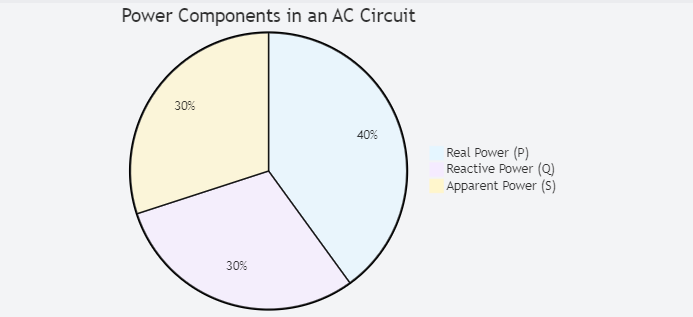
In an AC circuit, there are three main components of electrical power: real power, reactive power, and apparent power.
- Real Power (P): As mentioned earlier, real power is the power that actually performs useful work in the circuit. For example, in an electric motor, real power is used to rotate the shaft and drive mechanical loads. It is dissipated as heat, light, or mechanical energy.
- Reactive Power (Q): Reactive power is the power that is stored and then released back into the circuit by inductive or capacitive elements, such as motors, transformers, and capacitors. It doesn’t perform any useful work but is necessary to maintain the magnetic and electric fields in these devices. Reactive power causes current to flow in the circuit without contributing to the actual work output, resulting in additional losses and reduced efficiency.
- Apparent Power (S): Apparent power is the vector sum of real power and reactive power. It represents the total power flowing in the circuit and is the product of the voltage and current magnitudes.
The relationship between these three components can be represented using the power triangle:
Why Power Factor Matters
A low power factor can have several negative impacts on electrical systems, both for individual consumers and the power grid as a whole:
For Consumers
- Higher Energy Costs: Utilities often charge consumers based on the apparent power they consume. When the power factor is low, consumers end up paying for more apparent power than the actual real power they use. By improving the power factor, consumers can reduce their electricity bills as they will be consuming less apparent power for the same amount of real power.
- Equipment Overheating and Reduced Lifespan: Low power factor causes increased current flow in the electrical system. This excess current generates more heat in wires, transformers, and other electrical equipment, leading to premature wear and tear, reduced equipment lifespan, and an increased risk of equipment failure.
- Voltage Drops: The additional current due to low power factor can cause significant voltage drops in the electrical system, especially over long distances. This can affect the performance of sensitive electrical equipment, such as computers, servers, and manufacturing machinery, leading to errors, malfunctions, or even system shutdowns.
For the Power Grid
- Increased Transmission and Distribution Losses: Power plants and utilities need to generate and transmit more apparent power to supply the same amount of real power when the power factor is low. This results in higher transmission and distribution losses, as more energy is dissipated as heat in the power lines. Improving the power factor across the grid can significantly reduce these losses, leading to more efficient power generation and distribution.
- Reduced Capacity of the Power Grid: Low power factor reduces the effective capacity of the power grid. Power lines, transformers, and other grid infrastructure are designed to handle a certain amount of apparent power. When the power factor is low, these components need to carry more current, limiting the amount of real power that can be transmitted. By improving the power factor, the grid can operate at a higher efficiency and accommodate more load.
How to Improve Power Factor
There are several methods to improve the power factor of an electrical system:
Using Capacitors
One of the most common and effective ways to improve power factor is by using capacitors. Capacitors are electrical components that store and release electrical energy in an electric field. In an AC circuit with a lagging power factor (common in inductive loads like motors), capacitors can be connected in parallel with the load. The capacitors supply reactive power to the circuit, reducing the reactive power drawn from the power source. This effectively increases the power factor closer to 1.
For example, in an industrial facility with numerous electric motors, installing capacitor banks can significantly improve the overall power factor of the facility. BKPOWER offers a range of high – quality capacitor banks designed for various applications. Our capacitor banks are built with advanced technology to ensure reliable performance, long lifespan, and efficient power factor correction. They are available in different ratings and configurations to meet the specific needs of different electrical systems.
Load Management
Proper load management can also contribute to improving power factor. By balancing the electrical load across different phases, reducing the use of non – essential inductive loads during peak hours, and ensuring that electrical equipment is operated at its optimal load levels, the power factor can be enhanced. BKPOWER provides comprehensive load management solutions, including intelligent power distribution systems and energy management software. Our solutions help businesses monitor and control their electrical loads in real – time, enabling them to make informed decisions to improve power factor and reduce energy consumption.
Using Energy – Efficient Equipment
Upgrading to energy – efficient electrical equipment can also have a positive impact on power factor. Modern equipment, such as high – efficiency motors, transformers, and lighting systems, are designed to operate with a higher power factor. BKPOWER offers a wide range of energy – efficient electrical products, including UPS (Uninterruptible Power Supply) systems. Our UPS power supplies are not only designed to provide reliable backup power during outages but also feature advanced power management capabilities that help improve the power factor of the connected loads.
BKPOWER’s Role in Power Factor Improvement
BKPOWER is a leading provider of electrical power solutions, committed to helping businesses and industries optimize their electrical systems for maximum efficiency and reliability. Our product portfolio includes a comprehensive range of UPS systems, capacitor banks, energy management software, and intelligent power distribution systems, all designed to address the challenges associated with low power factor.
Our UPS power supplies are engineered with state – of – the – art technology. They not only ensure uninterrupted power supply during outages but also actively monitor and adjust the power factor of the connected loads. With features like power factor correction, our UPS systems can improve the overall power factor of the electrical system, reducing energy costs and enhancing equipment performance.
For example, our BKPOWER series UPS systems are suitable for a wide range of applications, from small office setups to large industrial facilities. They offer high – efficiency operation, low total harmonic distortion, and excellent power factor correction capabilities. Whether you need to protect sensitive IT equipment, manufacturing machinery, or critical communication systems, our UPS power supplies provide the reliable backup power and power quality you need.
In addition to our UPS systems, our capacitor banks are designed to provide effective power factor correction. They are built with high – quality components and advanced control algorithms to ensure stable and efficient operation. Our energy management software allows businesses to monitor and analyze their power consumption patterns, identify areas for improvement, and implement strategies to enhance power factor and reduce energy costs.
Conclusion
Power factor is a critical concept in electrical engineering that has a significant impact on the efficiency, performance, and cost of electrical systems. A low power factor can lead to higher energy costs, equipment damage, and reduced grid capacity. By understanding what power factor is and implementing the right strategies to improve it, businesses and industries can optimize their electrical systems, reduce energy consumption, and enhance their bottom line.
BKPOWER offers a comprehensive range of solutions to help you improve power factor and achieve greater energy efficiency. Our innovative products and services are designed to meet the diverse needs of different applications, ensuring reliable and efficient operation of your electrical systems. Whether you’re looking for a UPS power supply, capacitor bank, or energy management solution, BKPOWER has the expertise and products to meet your requirements. Contact us today to learn more about how we can help you improve your power factor and optimize your electrical systems.
References
- International Electrotechnical Commission (IEC)Official website: www.iec.ch
- Underwriters Laboratories (UL)Official website: www.ul.com
- European Committee for Standardization (CEN)Official website: www.cen.eu
- Standardization Administration of China (SAC)Official website: www.sac.gov.cn
- Zhongguancun Energy Storage Industry Technology Alliance (CNESA)Official website: www.cnESA.org
- International Organization for Standardization (ISO)Official website: www.iso.org